If You're on Google's First Page, Does ChatGPT Cite You?
by Cătălin Popa · updated 2026-10-23
ChatGPT searches the web before it answers, so it seems natural that whoever ranks first on Google also makes it into the answer. A study published on 11 October measured that link from inside ChatGPT and found it much weaker than people assume. We repeated the test for Romania, on everyday and business questions, and added what the study does not have: Romanian, Hungarian, English asked from Romania, and a comparison with Bing.
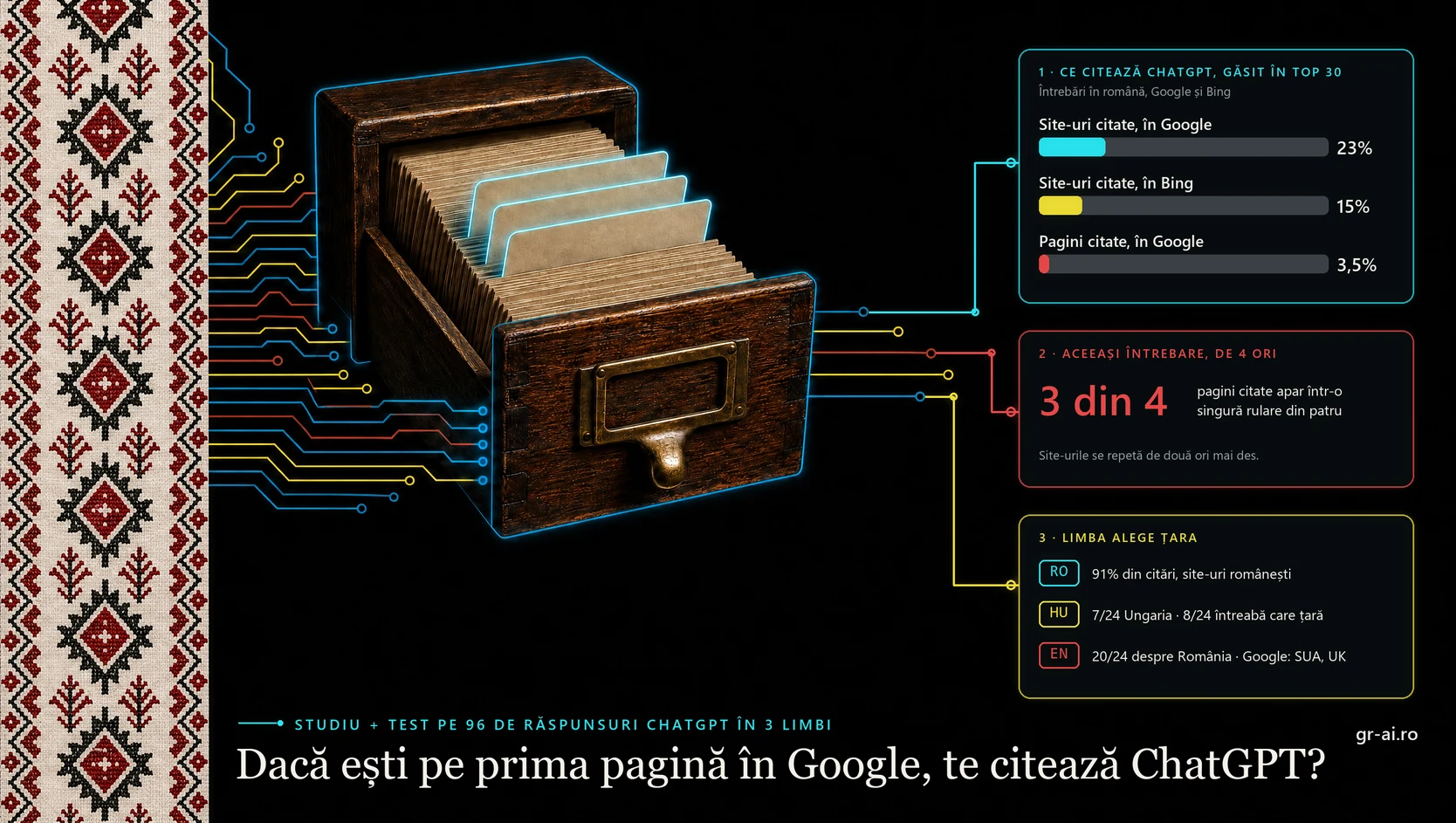
If my site is on Google's first page, will ChatGPT cite it too?
Most of the time, no. A study published on 11 October 2026 asked ChatGPT 80 questions 20 times each: the first five pages of Google contained only 6-9% of the cited pages and 23-26% of the cited sites. We repeated the measurement for Romania on 21 and 22 October, with 12 questions and 96 runs without an account, compared with the top 30 results from Google and from Bing. Only 3.5% of the pages ChatGPT cited and 23% of the sites appeared in Google; in Bing, 15% of the sites. Three in four cited pages appeared in only one run out of four. The language of the question changed the country too: in English, ChatGPT answered for Romania, and in Hungarian it often chose Hungary or asked which one was meant.
What the study measured
Researchers from Xi'an Jiaotong University and the National University of Singapore followed ChatGPT from the inside: what it searches for after it receives the question, which pages it finds and which ones it cites. They took 80 real questions, in Chinese and English, from the public Search Arena dataset, and asked each one 20 times, with GPT-5.3 Instant and GPT-5.5 Instant, between March and July 2026. Then they compared the citations with the first five pages of Google, 43 results on average, and with search in the OpenAI API.
- 0%of searches used the question exactly as written. ChatGPT rewrites it every time.
- 6-9%of the cited pages were in the first five pages of Google.
- 23-26%of the cited sites were there.
- 26-28%of the cited pages, even combining Google with search in the OpenAI API.
- 41-45%of the pages ChatGPT found appeared in only one run out of 20.
- 19-24%of the pages ranked below 15th in ChatGPT's own search were cited anyway.
The study does not say that ranking on Google does not matter. In the authors' model, rank in the results is actually the strongest signal, but only for the pages that Google or the OpenAI API do find. The problem is that Google finds only a small share of what ChatGPT cites. The study tests no optimisation technique, has not yet been peer reviewed, and its data is not public, only its code. And the models measured predate GPT-6, released on 7 October.
Other measurements, made differently, land in the same area. In August 2025 Ahrefs found that 8% of the citations in ChatGPT's text were in Google's top 10, and in September 2025, on short queries, 10% of the pages and 32% of the domains. Search Atlas, in January 2026: 7% of the pages and 21% of the domains. The only strong exception is a Seer Interactive study from February 2025, on about 100 questions: 87% of the citations were in Bing's top 20, against 56% for Google.
A Google ranking helps, but it is not enough. Most of the pages ChatGPT cites are not where you are looking.
Our test: 12 questions, 96 answers
On 21 and 22 October we asked ChatGPT 12 questions, without an account, from a computer in Romania, in a new conversation each time. The questions are about everyday life and business: the road vignette, an expired ID card, the annual tax return, registering as self-employed, heating assistance, an old apartment, solar panels, renting or buying, sole trader or limited company, a fee-free current account, a laptop for university, a mountain holiday with the kids. None of them names the country. In Romanian, each question ran 4 times; the same questions, translated, ran twice each in Hungarian and in English. On the same days we took the top 30 results from Google and from Bing for the questions in Romanian, and the first page for the others.
How much of what ChatGPT cites you find on Google and Bing
Across the 12 questions in Romanian, ChatGPT cited 115 different pages in total, from 74 sites. The comparison by site is exact. By page, for Google it is approximate, because Google does not show a result's full address; at most, 4.3% of the pages.
- 23%of the sites ChatGPT cited appeared in Google's top 30; 15% in the top 10.
- 15%of the cited sites appeared in Bing's top 30; 9.5% in the top 10.
- 3.5%of the cited pages appeared in the top 30 results, the same on Google and on Bing.
- 3 of 12questions had no cited site at all in Google's top 30.
Bing does not explain the citations any better. ChatGPT uses external search providers, and OpenAI names Microsoft indirectly, so we expected Bing to match better. It did not: in Bing's top 30 we found 15% of the cited sites, against 23% for Google. Question by question, the differences are large: for banks, 4 of the 5 cited sites were also on Google; for registering as self-employed, the old apartment and renting or buying, none.
Same question, different sources
Of the 115 pages cited for the questions in Romanian, 88 appeared in only one run out of four. Sites repeat more often than pages: two runs of the same question had, on average, 38% of their sites in common and only 19% of their pages. The study found the same pattern over 20 runs. The exceptions are questions with a single official answer: for the road vignette, the same page was cited in all four runs.
A single check tells you what ChatGPT cited once, not whether it cites you.
The language of the question picks the country
In September we asked Google AI Mode in Hungarian, from Romania, what to do when your identity card has expired. With no town in the question, it answered with the procedure in Hungary. This time we put the same sentence, and the other 11 questions, to ChatGPT, in three languages.
- Romanian · 48 answers91% of citations, Romanian sites
For all 12 questions, the answers relied on sources and figures from Romania.
- Hungarian · 24 answers7 about Hungary, 8 ask “Hungary or Romania?”
Hungary came from words with a single meaning: autópálya-matrica (the motorway vignette), egyéni vállalkozó (sole trader), kft. (limited company). For the identity card, the same sentence as in September, ChatGPT asked whether the card was Hungarian or Romanian in 2 of 2 runs. 53% of the citations were sites from Hungary, 25% from Romania.
- English · 24 answers20 about Romania, without being told
77% of the citations were Romanian sites. The exception: the question with British terms, sole trader and limited company, got the UK. For the same questions in English, from the same computer, Google and Bing returned results from the US and the UK: 1.6% of the sites ChatGPT cited were on Google's first page, none on Bing's.
The study found that, for questions in Chinese, ChatGPT searched only in English in about 7 out of 10 runs. In Romanian we did not see that in the citations: 91% were Romanian sites. But Romanian does not guarantee Romanian sources either: for “Is it better to rent or to buy a home right now?”, in three of four runs most of the sources consulted were in English, some of them about France, Sweden, the US or the UK. OpenAI says that when it rewrites the search, ChatGPT may also use the approximate location inferred from the IP address.
Google and Bing followed the language of the question. ChatGPT also took into account where it was asked from: in English it chose Romania, and in Hungarian it chose Hungary mostly when the words called for it.
One detail that repeats: in one of the answers about the identity card, ChatGPT wrote SPCEP instead of SPCLEP, the same acronym mistake AI Mode made in September.
What ChatGPT actually cites
If not Google's top results, then what? For the questions in Romanian, almost half of the citations were official sites. The rest were split between the sites of big brands, the press, guides and comparison sites. A few cases say more than the percentages:
- 45% official
Ministries, the tax authority, the trade register, the Interior Ministry, town halls, social assistance offices, the national legislation portal. In 31 of 48 runs in Romanian at least one official source was cited.
- Agerpres, the most cited site
13 citations for the questions in Romanian: 8 articles by the agency, 4 press releases from institutions published there and one paid press release, from the OTS section.
- Paid content, in 7 runs
Agerpres OTS press releases, for laptops, the mountain holiday and banks, and a HotNews advertorial marked [P], for banks, appeared among the sources consulted. They were actually cited twice.
- An “Official Gazette” that is not the Official Gazette
For the road vignette and for prosumers, ChatGPT cited 7 times, under the label “Monitorul Oficial” (the Official Gazette), a private site for tracking court cases that republishes the acts. The actual Official Gazette did not appear.
- An address that no longer exists
For the land register extract, ChatGPT once cited ANCPI's ePay platform. The domain has not existed since the summer; we checked it on 15 October and again on the 22nd.
Our reading: ChatGPT does not take the top result, but the page that seems to answer directly, with a figure, a date and an institution behind it. Where the official page is missing, hard to find or offline, it takes whatever it finds instead: a copy, a press release, an advertorial or an address that no longer exists.
What it means for a business
- 01Do not measure yourself by your Google rank.
Rank helps, but it does not guarantee a citation. Check directly what the assistants cite for the questions your customers ask.
- 02Repeat the same question.
One run is a snapshot. Ask the same question several times and look at what stays from one run to the next.
- 03Count sites, not pages.
Cited pages change often, sites less so. Your presence shows better at the level of the site and the brand than on any single URL.
- 04Check every language your customers use.
The same service gets different sources in English or in Hungarian. A customer in Cluj asking in Hungarian may get the answer for Hungary.
- 05Be the page that answers directly.
The pages cited were the ones with a clear answer: the figure, the date, the conditions, the country. A service page that states them explicitly stands a better chance than one that sends you elsewhere.
- 06Look beyond your own site too.
Press releases, comparison sites and the press show up often among the sources. If the information about you there is old or wrong, it ends up in the answer too.
What we do not know
The test is small compared with the study and has clear limits:
Without an account you cannot see what ChatGPT actually searches for, only what it finds and cites. We infer the search language from the sources.
4 runs per question in Romanian and 2 in Hungarian and English, against 20 in the study. 12 questions, not 80.
The runs spread over two days, 21 and 22 October, and some were redone on the 22nd after a capture problem. Google blocked collection on the 21st after 42 pages; the rest were taken on the 22nd.
Without an account, ChatGPT uses the free model; we cannot confirm the model behind each answer. With an account, history and memory can change the sources.
One computer, one location. Google and Bing were read from a browser, not through an API, and on Google the pages are only approximated.
Wording matters: the English question with British terms got the UK. A different wording might have given a different result.
Frequently asked questions
- If I rank first on Google, do I show up in ChatGPT?
- Not necessarily. In our test, only 23% of the sites ChatGPT cited were in Google's top 30 results, and of the pages, 3.5%. Rank helps, but most citations come from other pages.
- Does ChatGPT use Google's results?
- OpenAI says ChatGPT sends the rewritten question to external search providers and names Microsoft indirectly. The press reported in 2025 that OpenAI had also used Google results, but nobody confirmed it. In our test, the citations matched Bing even less well than Google.
- Why does ChatGPT cite different sources every time?
- It rewrites the question, sometimes into several searches, and chooses from what it finds at that moment. In our test, three in four cited pages appeared in only one run out of four. Sites repeat more often than pages.
- Does the language the customer asks in matter?
- Yes. In English, from Romania, ChatGPT answered for Romania in 20 of 24 cases. In Hungarian it chose Hungary in 7 of 24 and asked “Hungary or Romania?” in another 8.
- Which sites does ChatGPT cite most often for questions about Romania?
- In our test, official sites, with 45% of the citations, and Agerpres, the most cited site, including with press releases. Then come the sites of big brands, the press and guides.
- Can I stop ChatGPT from citing my site?
- Yes. OpenAI says sites that block OAI-SearchBot in robots.txt are not shown in ChatGPT's search answers. GPTBot is a different matter: it is about training, not citation.
Where the data comes from
- The study. Jiang, Zhang, Xing, Chang and Xiao, “Understanding ChatGPT Citations: Evidence from Production Web Search Across Model Generations”, arXiv 2610.15382, version 1, 11 October 2026, read in full.
- Other measurements. Ahrefs (11 August and 3 September 2025), Search Atlas (26 January 2026) and Seer Interactive (6 February 2025), read on their own pages.
- OpenAI. The help article “Searching the web with ChatGPT”, updated on 20 October 2026, and OpenAI's crawler documentation.
- Our test. 12 questions fixed before the first run, asked to ChatGPT without an account on 21 and 22 October 2026, 4 times in Romanian and twice each in Hungarian and English, in a new conversation per run; the sources consulted and the citations, read from the answer; the top 30 Google and Bing results for the questions in Romanian and the first page for the others, on the same days, with non-essential cookies rejected; the country of each answer in Hungarian and English, rated by a separate evaluator. The Google AI Mode test in Hungarian, from 15 September 2026.
Share this article
Further reading
- Which country does an AI assistant pick when you ask in Hungarian from Romania?The September test with Google AI Mode that part three builds on
- Why Google cites itself in AI ModeThe other half of AI search: what Google cites
- What AI agents read when someone asks about your companyWhat they find on the site once they get there
- If you want the test run on your customers' questionsIn their languages, several times, with the sources counted