Should We Panic That Google Is Citing Itself in AI Mode?
by Cătălin Popa · updated 2026-09-23
The classic industry answer is “it depends.” But since a random “it depends” doesn't pay anyone's bills, I did the grunt work myself. I dissected both studies down to the last comma and tested the theory, just today, on one of our clients. Because in-the-trenches practice always beats internet theory.
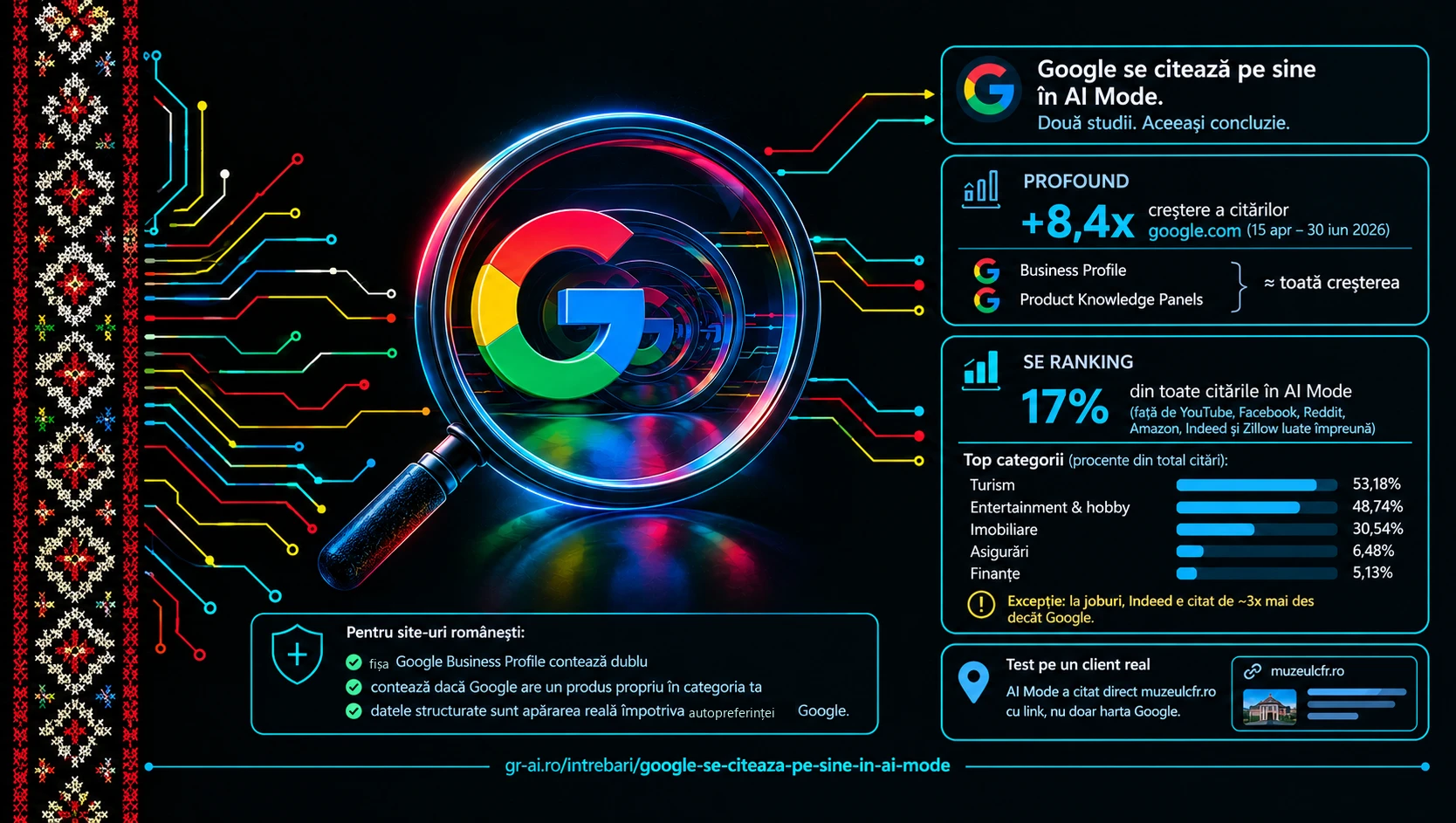
What these two studies actually mean
No, this isn't that classic game of telephone where everyone parrots the same tired PR. We're talking about two different companies, with different methodologies, arriving independently at the exact same conclusion. That's exactly why they deserve separate scrutiny, not just being lumped together to pad a catchy stat.
Profound: an 8.4x jump in just two and a half months
While some were sleeping at the wheel between April 15 and June 30, 2026, Profound tracked over 32 million AI Mode instances. In that window, the citation share for the google.com domain exploded by 8.4 times, enough to make it the second most cited domain on the internet. Where is the traffic going? Almost exclusively down two avenues: Business Profiles and Product Knowledge Panels. Surprised? Not really. It's the exact area where AI Mode can spoon-feed you the answer straight from the data Google already hoards in its backyard, without bothering to send you to your site.
SE Ranking: the undisputed king in 19 out of 20 categories
SE Ranking individually chewed through 68,313 keywords and 1,321,398 AI Mode citations. The verdict: google.com now gobbles up 17% of total citations, beating out giants like YouTube, Facebook, Reddit, Amazon, Indeed, and Zillow combined. In 19 out of the 20 niches analyzed, Google cites itself more than anyone else.
If you're in certain industries, I have bad news. The breakdown looks like this:
- Travel53,18%
- Entertainment and hobbies48,74%
- Real estate30,54%
- Insurance6,48%
- Finance5,13%
Of these self-citations, 59% funnel you toward standard organic results, 36% to Business Profiles, and the rest is sprinkled across Google Support or Flights. The pattern is painfully predictable: wherever Google has its own shiny toy (a proprietary product), it's going to play with it and cite itself.
The Exception That (Still) Gives Us Hope
The only slice of the market where Google doesn't dictate the law is jobs. For “careers” or “jobs” queries, Indeed beats them to a pulp (cited three times as often), and LinkedIn is sitting comfortably at the table too.
Why? Because the search intent here is transactional and direct, which pushes the AI toward perfectly structured databases, not a generalist aggregator.
Indeed and LinkedIn have their own inventory, served up algorithmically on a silver platter, and AI Mode rightfully considers them authoritative. The TL;DR lesson for mere mortals who don't own Indeed: if Google doesn't have a solid product to steal your lunch in your specific category, a site with flawlessly structured data can still steal the spotlight. But if they do, you're starting the match down 1-0.
What I Tested Directly (Because I Don't Blindly Trust Studies)
Blog theories are cute, but the reality on the ground is what gives us headaches. So today, I threw a basic, local query at Google AI Mode, exactly the kind that should have been monopolized by a Business Profile: “what are the hours for muzeul cfr” (targeting our client, muzeulcfr.ro).
The result? Google slapped a map on top (because, well, it's Google), but the text that actually answers the question religiously cites muzeulcfr.ro, complete with a link. And on the right, a sleek card sends you right back to the client's page, not to a generic Google profile. The map stole some visual real estate, but it didn't cancel our citation.
Obviously, we're not writing SEO bibles based on a single search. But it does show something clearly: the general panic that “Google only cites itself” is just a mantra for alarmists. It rolls over you like a steamroller only where Google has already built out an ecosystem. Where it hasn't, a technically excellent site still schools them, just like Indeed does.
What This Actually Means in Real Life for a Website
- Your Google Business Profile Just Got a Promotion.
It's no longer just a tired pin on a classic search map. Now, for local queries, it shows up directly in the AI Mode answer, right next to your citation or directly over it. If your hours, categories, and photos are stuck in 2019, don't act shocked when the AI gracefully ignores you. It has become the raw material the model uses to build its sentences.
- Are You on Their Turf or Yours?
Travel, entertainment, and real estate get slaughtered in the SE Ranking study for one simple reason: Google has Google Hotels, Google Flights, YouTube, and Maps. If you sell plane tickets, you have a problem. But if you run a dental clinic, an auto shop, or an ultra-specialized niche store, you can sleep soundly. Google doesn't (yet) have a tooth-extraction division, so the Indeed rule saves you.
- Structured Data Is Your Armor, Not a Vanity Metric.
Indeed doesn't win because it has a nice logo; it wins because it has technical inventory served up on a platter. The exact same logic applies to any site with textbook schema.org implementation, explicitly declared hours, and spoon-fed answers for clients. Nobody guarantees it will eliminate Google's advantage, but at least it qualifies you for the finals instead of watching the game from the sidelines.
Where the data comes from
- Profound. The analysis of over 32 million AI Mode instances, 15 April to 30 June 2026, published on the company's blog.
- SE Ranking. The analysis of 68,313 keywords and 1,321,398 citations, with the category breakdown, reported by Search Engine Journal.
- Our own test. One query put directly into Google AI Mode about muzeulcfr.ro, on the date at the top of this page. It can be repeated any time, with any site.
Share this article
Further reading
- Why my competitors show up in AI answers and I do notThree measured causes, from before Google started citing itself
- What structured data actually does for AIThe same defence that pulls Indeed out of this article's pattern
- All the questions explainedIn the order it makes sense to read them
- If you want the test run on your own siteThe same query, on your own Google listing and your own category