Which country does an AI assistant pick when you ask in Hungarian from Romania?
by Cătălin Popa · updated 2026-09-16
In October 2025 UDMR, the party representing Romania's Hungarian minority, announced ErdélyGPT, a Hungarian-language AI assistant for Hungarians in Transylvania. People explain their problem in Hungarian, and the app prepares the document in Romanian, for Romanian institutions. In May 2026 UDMR said development had not started. Meanwhile three web addresses carrying the ErdélyGPT name have appeared, and UDMR has not said which of them, if any, is its own.
Whatever happens to the project, ErdélyGPT raises a question every AI assistant gets daily: when someone writes in one language but lives in another country, how does the system decide which law, which institutions and which fees it is talking about? We gathered what has already been measured about how assistants search, and tested the concrete case.
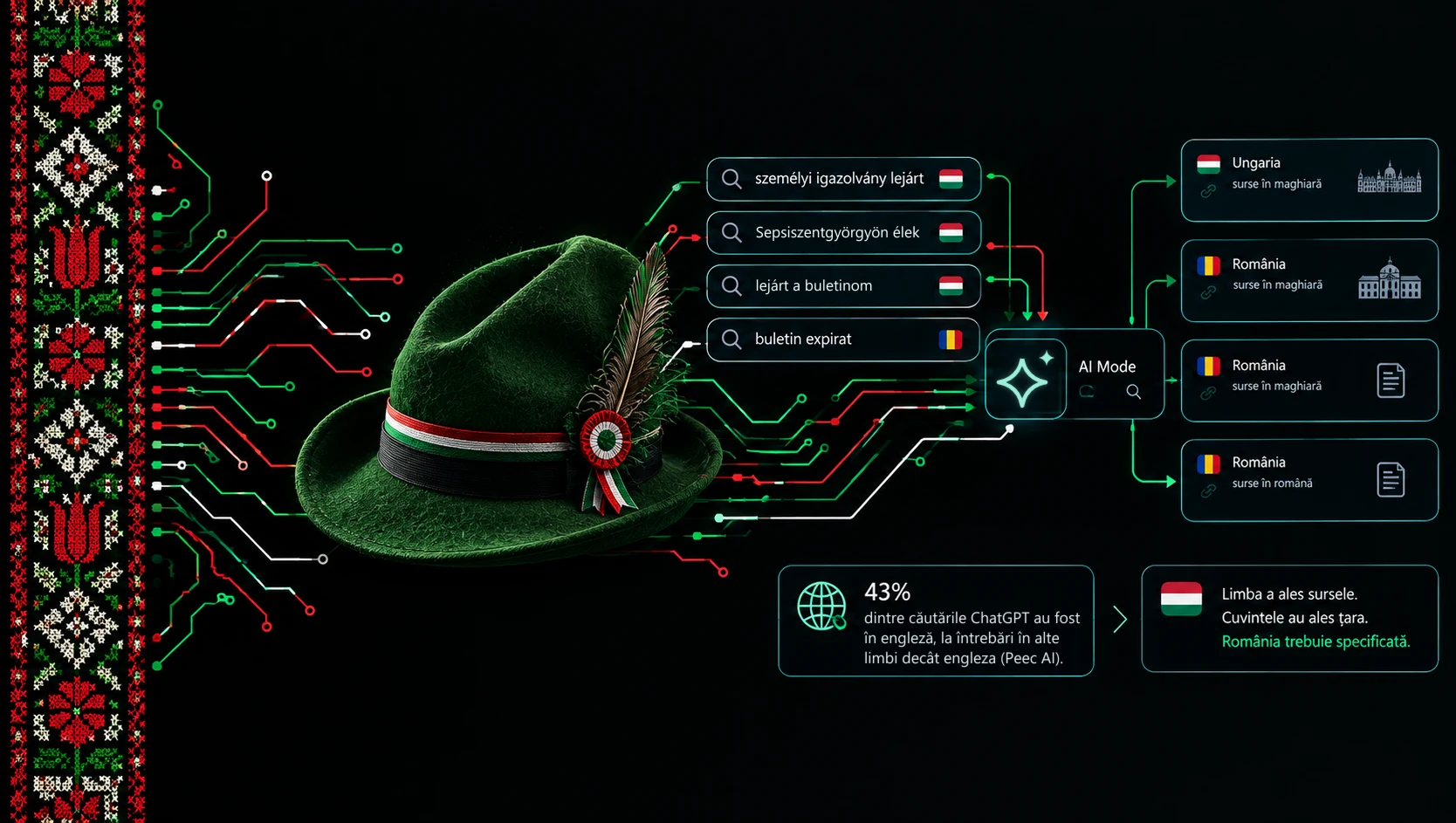
How an AI assistant searches
An AI assistant connected to the web does not search for your question as you wrote it. Google describes AI Mode as a system that runs several searches in parallel, across subtopics and multiple sources, and then brings them together into a single answer. The technique is called query fan-out.
How many searches depends on the system and the question. Nectiv extracted the searches Gemini made for almost 9,000 questions: 9 per question on average, with 59% of questions between 5 and 11. For questions about local services the average dropped to almost 4. Seer Interactive measured 10.7 searches per question on Gemini 3, and for ChatGPT Nectiv counted 7.6 in 2026, against 2.2 a year earlier. Both Gemini studies used the developer API, and Nectiv notes it cannot be sure AI Mode works the same way.
For our case the language of those searches matters more. Peec AI, a company that sells AI search monitoring, analysed more than 20 million searches made by ChatGPT. For questions asked in languages other than English, 43% of the searches were in English, and almost 78% of sessions included at least one English search. ChatGPT starts in the user's language and carries on part of the research in English. For questions in Turkish, 94% of sessions included English searches; for Spanish, the lowest figure, 66%.
Peec's data comes from its customers' questions, run automatically, not from real conversations, and Hungarian and Romanian do not appear in the published results. The effect is visible from the outside too. Glenn Gabe asked questions in French, Italian and Spanish: ChatGPT, Perplexity and Claude answered in the language of the question but cited the English version of the pages, although local versions existed. Google AI Mode and Copilot cited the right version.
In short: your question becomes several searches, some perhaps in another language, and the answer comes back fluently in yours. Nothing in the final text tells you any of this.
The test: one problem, four wordings
On 15 September 2026, from a computer in Romania with Google set to Romanian, we put the same problem to Google AI Mode: an expired identity card. Only the wording changed. Each variant ran once, and AI answers change from one run to the next, so what follows is an observation, not a statistic.
1In Hungarian, no town named
Answer for HungaryLejárt a személyi igazolványom, mit tegyek?
My identity card has expired, what should I do?
The answer: Go to a Hungarian government office, book an appointment on Magyarország.hu, bring your Hungarian address card, and the document is ready in 8 days, free of charge.
Sources: Hungary only: Officina.hu, money.hu, Magyarország.hu, Kormányhivatalok. The notice under the answer appeared in Romanian.
2In Hungarian, with the town
Answer for RomaniaSepsiszentgyörgyön lakom, lejárt a személyi igazolványom, mit tegyek?
I live in Sfântu Gheorghe, my identity card has expired, what should I do?
The answer: The personal records office in Sfântu Gheorghe. Only electronic identity cards are issued, the first one is free, with online booking and the list of documents required.
Sources: Sfântu Gheorghe town hall pages in Hungarian, and its Facebook posts.
3In Hungarian, with “buletin”
Answer for RomaniaLejárt a buletinom, mit tegyek?
My “buletin” has expired, what should I do? With the colloquial Romanian word inside the Hungarian sentence.
The answer: The personal records service, documents, fees in lei. The institution's acronym is misspelled, S.P.C.E.P. instead of S.P.C.L.E.P. At the end it asks whether the Hungarian card was meant and, for that one, points only to government offices in Hungary.
Sources: The town halls of Odorheiu Secuiesc and Satu Mare, UDMR, evpcv.ro, kezdi.info, all in Hungarian, plus the Hungarian government.
4In Romanian
Answer for RomaniaMi-a expirat buletinul, ce fac?
The ordinary Romanian wording of the same question.
The answer: The personal records service, booking, documents, the 7 lei fee for the classic card.
Sources: The Oradea and Brașov personal records offices, Libertatea, Avocatnet.
The same question in classic search
For comparison, we ran the first wording, with no town, in classic Google search too. Of the first nine results, five were from Hungary, three from Romania and one unclear. On the same page, an official Hungarian source said a new card can be requested at most 60 days before expiry, while a Hungarian-language news site in Romania said 180 days. Each was talking about a different country. The list of links showed the ambiguity. The AI answer picked one country and did not say it had picked.
What the test shows
- The language chose the pool of sources, the words chose the country. In all three Hungarian variants the sources were in Hungarian. The country came from the words: the town's name or a single Romanian word moved the answer from Hungary to Romania.
- Where you ask from changed nothing. In the first variant we were in Romania, with Google in Romanian, and the notice under the answer was in Romanian. The answer was entirely about Hungary.
- AI Mode did not switch to English. No source was in English, unlike what Peec AI found for ChatGPT. AI Mode does not show its searches, so we infer this from the sources, not from the searches themselves.
- The right sources exist. Romania's Administrative Code requires local administration to ensure use of the mother tongue where a minority exceeds 20% of the population, and town halls such as Sfântu Gheorghe and Odorheiu Secuiesc publish their procedures in Hungarian. AI Mode found them as soon as it had a hint.
- The mistakes are small and they matter. A misspelled acronym and an incomplete route for dual citizens. For the Hungarian card, the answer pointed only to offices in Hungary, although Hungary's consulates in Cluj and Miercurea Ciuc issue Hungarian passports and identity cards.
What an assistant for Hungarians in Romania has to do
We do not know how ErdélyGPT will be built, if it is built. We do know what any assistant of this kind would need to solve, going by the test above.
- 1Fix the country, do not guess it. Romania has to be stated explicitly in the system instructions and added to every search, and the town has to be asked for at the start. Otherwise whoever writes the way people do in Hungary gets Hungary.
- 2Search where the law is. The sources have to be Romanian official ones and the Hungarian-language pages of local administration. Searches in Hungarian only bring up Hungary, and searches in English can bring up general sources with no connection to Romania.
- 3Show the source and the date. Fees and procedures change. Transtelex tested a chat carrying the ErdélyGPT name on exactly this, renewing an identity card, and the fee it gave could not be found in official sources.
- 4Ask which document is meant. Many Hungarians in Romania also hold Hungarian citizenship. “I want to renew my identity card” can mean the Romanian card, from the personal records office, or the Hungarian one, from Hungary's consulates in Cluj and Miercurea Ciuc.
- 5Keep names exact. The final document is in Romanian and goes to a Romanian official. An approximately translated acronym or institution name is no longer a matter of style.
- 6Explain what you sign. The document is written in Romanian for someone who may not feel confident in Romanian. The assistant has to explain in Hungarian what it contains and what needs checking before signing, because the person who needs it most is the one least able to check the result.
- 7Say who runs it. People will type personal, tax or family details into the chat. The chat carrying the ErdélyGPT name that already works does not name its operator on its home page.
What it means for a business or institution in Romania
The Hungarian case is only the most visible one. The same mechanisms are at work when a customer asks in Romanian.
- A question in Romanian does not guarantee Romanian sources either. If ChatGPT runs part of its searches in English for questions asked in other languages, a customer asking in Romanian can get an answer built from international sources, delivered fluently in Romanian. It is worth checking, on customers' real questions, which sources the assistants cite.
- Put the place in the text. In our test, the town's name moved the answer to another country. A page that states the town, the county and Romania explicitly can be matched to a local question. One that assumes the reader already knows where the business is gives the system less to go on.
- Use your customers' words. “Buletin” took the answer to Romania. The UDMR guide cited by AI Mode puts the word “buletin” right next to the official term. People do not ask questions in the vocabulary of institutions.
- For Hungarian-speaking customers, Hungarian pages with Romanian context. A business in Transylvania with pages in Romanian only risks leaving Hungarian questions to sources from Hungary. A Hungarian page that says clearly it is about Romania has something to offer an answer about Romania.
What we do not know
The test has clear limits, and we state them plainly.
- How ErdélyGPT will be built, on which model and with which sources. UDMR has published nothing technical.
- Which of the addresses carrying the ErdélyGPT name, if any, is UDMR's project.
- How ChatGPT behaves with the same question in Hungarian. We did not test it, and Peec AI has published no Hungarian data.
- Which searches AI Mode actually ran. Google does not show them.
- Whether the result repeats. Each variant ran once.
Where the data on this page comes from
- The search technique in AI Mode. Google's blog, 5 March 2025, the AI Mode announcement, with the description of query fan-out. blog.google
- The number of searches on Gemini. Nectiv, 3 December 2025, more than 60,000 searches extracted through the API for almost 9,000 questions. nectivdigital.com
- Gemini 3. Seer Interactive, 21 November 2025, 501 questions with Google Search grounding forced on. seerinteractive.com
- The number of searches on ChatGPT. Nectiv, 13 August 2026, almost 4,000 questions. nectivdigital.com
- ChatGPT's English searches. Peec AI, the analysis of more than 20 million searches. peec.ai
- The limits of the Peec study. Search Engine Journal, 18 February 2026, noting that the data comes from a vendor and from automatically run questions. searchenginejournal.com
- The language of cited pages. Glenn Gabe, 1 December 2025, questions in French, Italian and Spanish. gsqi.com
- ErdélyGPT. Transtelex, 14 September 2026, the state of the project and the identity card test. transtelex.ro
- Mother tongue in local administration. Romania's Administrative Code, Article 94. infoinstitutii.ro
- Hungarian documents issued in Romania. Hungary's consulate general in Miercurea Ciuc, the page on the electronic identity card. csikszereda.mfa.gov.hu
The figures on the number and language of searches come from the studies above, not from gr.AI measurements. The identity card test of 15 September 2026 is ours.
Share this article
Further reading
- Why is there no Siri AI on iPhone in the EU?Also about language, region and what users here actually get
- Why my competitors show up in AI answers and I do notThe measured causes, from a scan of Romanian businesses
- How do I check whether an AI can read my siteThe first step, before language and sources
- All the questions explainedIn the order it makes sense to read them
- If you want to know which sources and language the assistants use for your customersMeasured on real questions, dated