How big is AI search, when the numbers come from the people selling it?
by Cătălin Popa · updated 2026-11-09
Nobody outside knows how big AI search is, and the figures in circulation come from those who sell it. In nine days, between 28 October and 5 November, AI search received three big numbers. OpenAI said how big ChatGPT is next to Google. Google said how much it earns from AI answers. ChatGPT ads passed 200,000. All three come from someone selling something: the product, the ad, or the tool that measures it. The AI answer has become a shop window, and the window is being rented out before anyone outside has measured it.
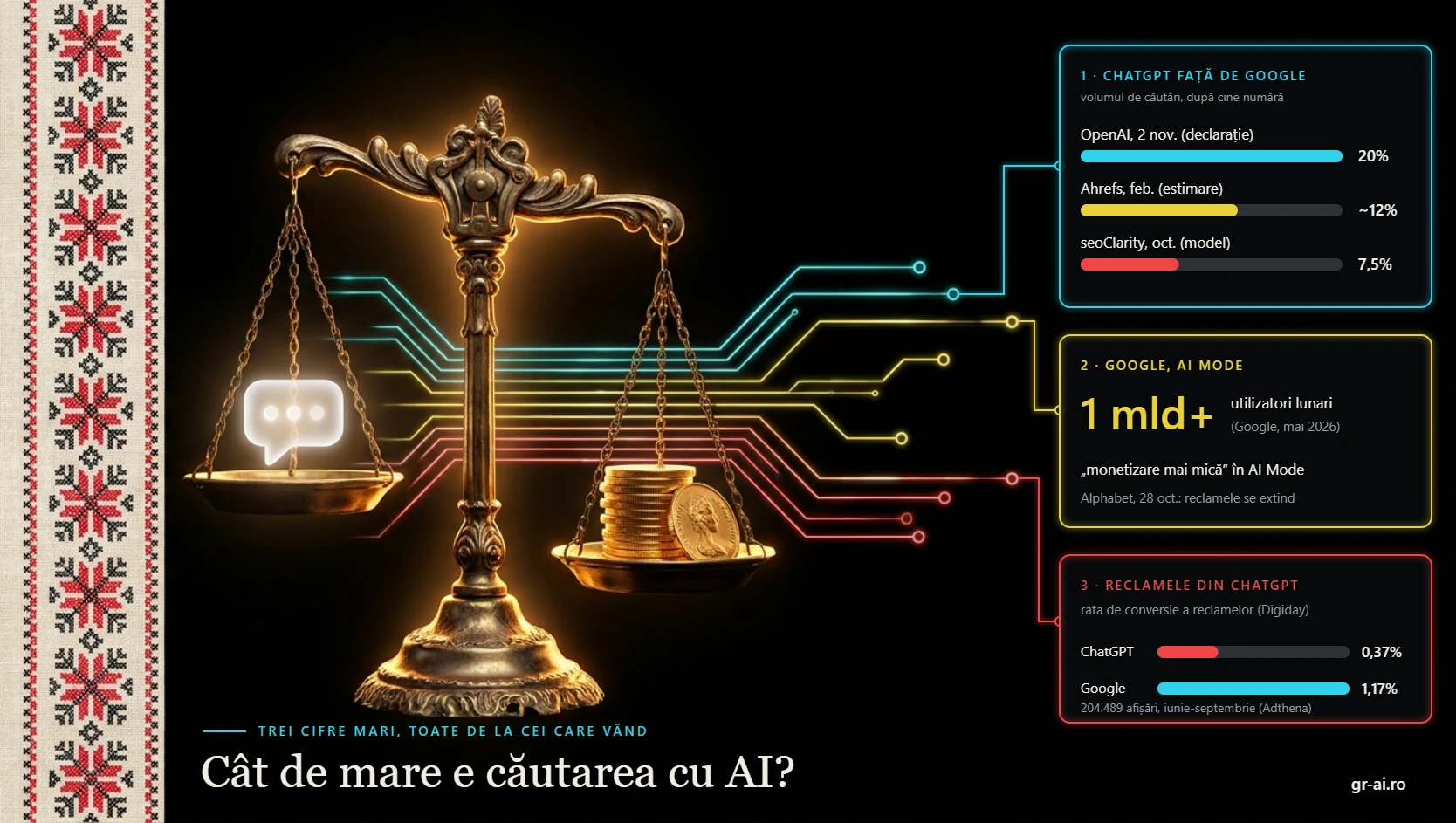
One fifth, depending on who counts
Adam Fry, who runs ChatGPT for consumers, said at an OpenAI dinner in New York that the volume of “search-like” queries is now roughly one fifth of Google's. OpenAI does not say what “search-like” means, nor how it counts a conversation with ten turns. The company is not listed, so the figure passes through no auditor.
- 20%OpenAI, 2 Nov 2026 (statement)
- ~12%Ahrefs, Feb 2026 (estimate)
- 7.5%seoClarity, Oct 2026 (model)
Those counting from outside land lower. Ahrefs estimated about 12% in February, starting from the author's assumption that 65% of messages sent to ChatGPT resemble a search. seoClarity reached 7.5% in October and says itself that it is “a modeled comparison, not a measured market-share figure.” Between the lowest and the highest figure there is a factor of almost three. The gap comes from what you count as “a search”.
Google: more questions, less money per question
On 28 October, on the quarterly earnings call, Google's chief business officer, Philipp Schindler, said the strong growth in AI Mode queries weighed on search revenue growth “because of the lower monetization we were seeing in AI Mode”. Currency remains, in his words, the largest single driver. Right after, he announced the remedy: ads in AI Overviews and AI Mode are scaling to more users, more queries and international markets.
The audience is large by Google's own figures too: AI Mode passed one billion monthly users (May 2026) and AI Overviews 2.5 billion (June 2026). In plain words: the answer keeps people inside Google, but it sells worse than the list of links. The space next to the answer, naturally, goes up for sale.
ChatGPT ads: plenty of them, little proof
Adthena counted 204,489 ad placements in ChatGPT between June and September 2026, in five categories: apparel, electronics, travel, toys and beauty. The release does not say what a “placement” is or how it was measured. Also per Adthena, the number of brands observed rose from 1,082 in June to 6,333 in August, across four markets.
Digiday set beside these figures a study not yet peer reviewed, on data from online shops: paid visits from ChatGPT convert at 0.37%, those from Google ads at 1.17%. A visitor from a ChatGPT ad brings 0.89 dollars, one from Google 2.45. OpenAI says ads “do not influence the answers”. Axios reported in April, citing a source on investor presentations, that OpenAI is aiming for 100 billion dollars in ad revenue by 2030. At 0.37% conversion, that is a long road.
What we saw, with no ads at all
On 27 and 28 October we read 147 AI answers to 15 everyday Romanian government tasks: road toll, criminal record, land registry extract. Of ChatGPT's answers, 90% linked the official site and 3% an intermediary. Of Google AI Mode's answers, 53% also showed a fee-charging intermediary next to the state's site. No ads involved. The answer was contested before it was for sale.
The first outside numbers arrive in December
ChatGPT was designated a very large online search engine in the EU on 31 August 2026. That triggers a Digital Services Act duty: by the end of December, OpenAI has to publish a searchable repository of every ad shown in ChatGPT, who paid for it, how long it ran, whom it targeted and how many people it reached, per member state. For the first time, someone outside the company will be able to count.
Romania is already on the map: since August, OpenAI sells ads in 31 European markets, and Ads Manager lists Romania as available to buyers. Ads appear only to users without a paid plan (Free and Go) and, in the European Economic Area, unpersonalised.
What it means for a company in Romania
- Measure the answer, alongside the traffic.
Volume figures disagree by a factor of three. What an assistant says about you, on your customers' questions, can be read directly, on each engine and in each language. That depends on nobody's definition.
- The ad will sit beside the answer.
Both Google and OpenAI place the ad next to the generated text. The text is written from whatever the assistant finds. If it cannot find your price, hours or correct address on your site, it takes them from the intermediary who wrote them first.
- The facts on your site are the only free part.
Of 30 Romanian businesses we checked in October, 10 had prices on the home page. The other 20 leave the assistant only the option of quoting someone else, and the space next to the answer will be sold anyway.
What we do not know
The big figures in this piece are company statements or models from firms that sell measurement tools. We have not measured ChatGPT ads in Romania and do not know how many Romanian users already see them. Our own test is small: 147 answers, over two days, logged out, on one computer. And the conversion-rate study has not yet been through peer review. We sell measurement too, so our figures deserve the same magnifying glass.
When the answer has an ad underneath, who will be in the answer: you, the intermediary, or whoever paid?
Where the data comes from
- OpenAI on volume. Adam Fry, interview with Alex Kantrowitz, Big Technology, 3 November 2026. bigtechnology.com
- Ahrefs. Patrick Stox, 11 February 2026. ahrefs.com
- seoClarity. Mitul Gandhi, 28 October 2026. seoclarity.net
- Alphabet, Q3 results. Earnings call transcript, 28 October 2026. fool.com
- Google on AI Mode. Google blog, 19 May 2026; investor presentation, 3 June 2026. blog.google
- Adthena. Press release, 4 November 2026. finance.yahoo.com
- Digiday. Krystal Scanlon, 5 November 2026. digiday.com
- Axios. 9 April 2026, on the ad revenue target. axios.com
- OpenAI on ads. “Testing ads in ChatGPT”, 9 February 2026, updated in August. openai.com
- OpenAI, markets for ad buyers. Help Center, “Ads Manager Availability”. help.openai.com
Share this article
Further reading
- Does AI send you to the official site?The 147 answers in this article, in full
- The ChatGPT ad repositoryWhat OpenAI has to publish by December
- Does ChatGPT cite you if you rank first on Google?23% of sites, 3.5% of pages
- If you want the answer about your company readOn each assistant and in each language