Romania's AI Ministry: What It Inherits on Day One
by Cătălin Popa · updated 2026-10-15
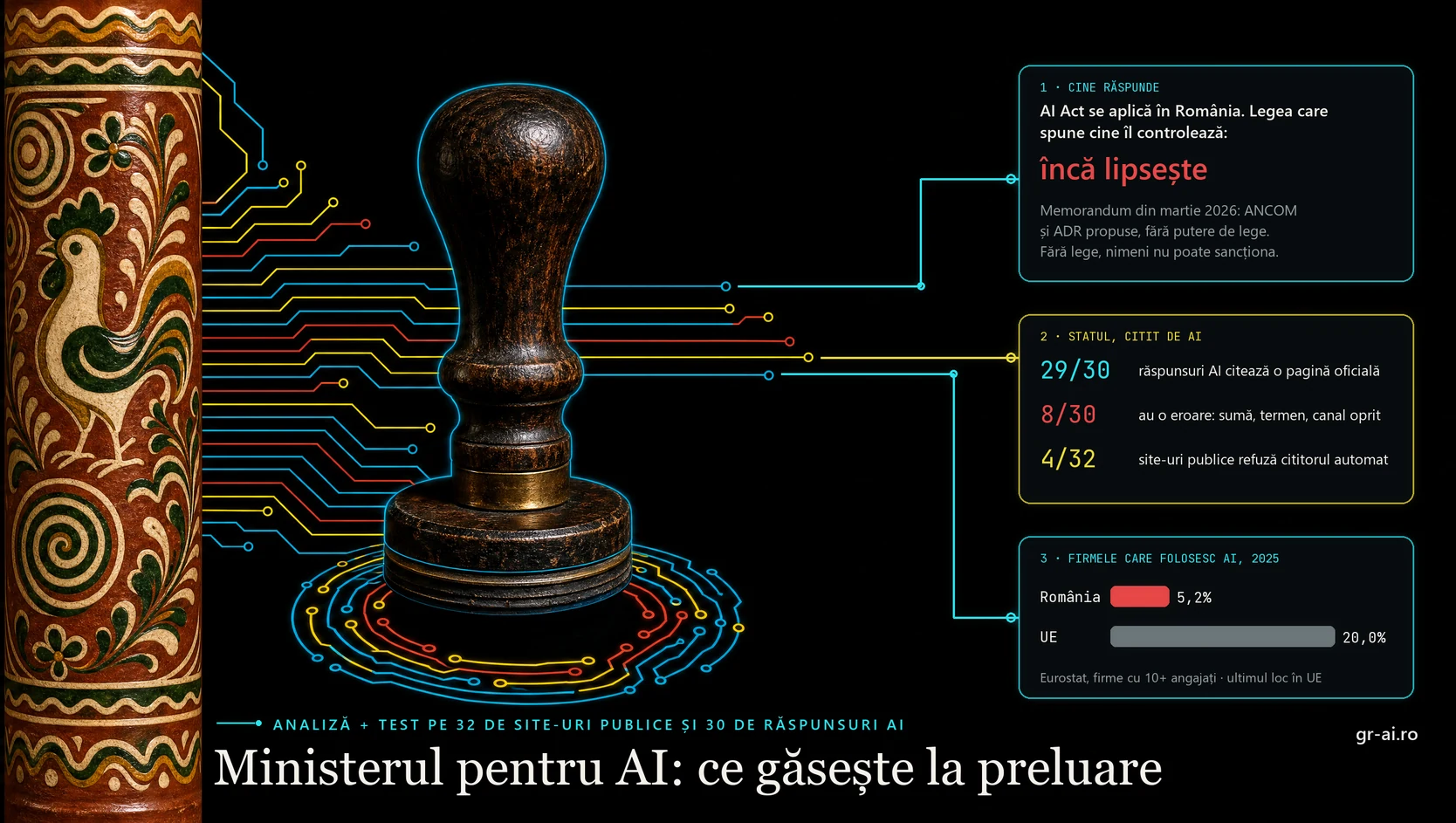
The government proposed by Luca Niculescu has, for the first time in Romania, a ministry with artificial intelligence in its name. Its remit is not public yet, so we looked at what it finds on the table on day one. There are three things: the EU rules on AI already apply, but Romania still has no law saying who enforces them; the state's websites are hard for AI assistants to read, and those assistants already answer citizens; and Romanian businesses use AI almost four times less often than the EU average. For the second part we ran our own test.
What would an AI ministry do in Romania, and where does it start from?
The government proposed by Luca Niculescu includes, for the first time, a Ministry for Communications and Artificial Intelligence, led by a technocrat; the name being floated is Bogdan C. Dumitru, Chief Scientist at Bitdefender. Its remit is not public yet. The ministry inherits three things. The AI Act already applies, but the law that designates the authorities and sets penalties in Romania does not exist, so nobody can impose sanctions. AI assistants cite the state, but in our test 8 of 30 answers about public services contained an important error, mostly where the official page was outdated, hard to read or offline. And only 5.2% of Romanian businesses use AI, against an EU average of 20%, the lowest in the Union.
Status on 15 October 2026: the ministry and the minister's name come from the press, citing sources in the negotiations. The official list of the Niculescu government is being filed in Parliament on 15 October; the ministers' hearings are expected on 19 October and the confidence vote on 20 October. We will update this article after the vote.
Who is in charge of AI in Romania today
On 14 October, several outlets reported, citing sources in the negotiations, that the Niculescu government would have 17 ministries, and that a new one would be called the Ministry for Communications and Artificial Intelligence, led by a technocrat agreed with the president. Other sources describe a Ministry of Communications with a department dedicated to AI. The remit has not been made public. Among the options cited: communications policy, coordinating the digitalisation of public administration, an AI strategy for the public sector, and support for Romanian AI companies.
The name being floated for the ministry is Bogdan C. Dumitru. He has worked at Bitdefender since 2001, was the company's chief technology officer until 2024, and has since been its Chief Scientist, tasked with following the AI research that can make it into products. He holds a PhD in natural language processing from the University of Bucharest, where he teaches at the Faculty of Mathematics and Computer Science, including a course on the computational foundations of Transformer models, the architecture behind ChatGPT. He has no political or central government experience and has made no public statements as the proposed minister.
Who does what, today
ANCOMProposed as the market surveillance authority and single point of contact for the AI Act. It is an autonomous authority under parliamentary control, so it cannot be placed under a ministry.
ADRProposed as the notifying authority: it assesses and monitors the bodies that certify AI systems. It has sat under the Ministry of Economy, Digitalisation, Entrepreneurship and Tourism since December 2024; moving it to the new ministry would need a new legal act.
ANSPDCP, ASF, BNRANSPDCP for biometrics, migration, justice and democratic processes; ASF and BNR for high-risk systems in financial services.
ITM, ANPC, ANR, ISCIR, ANMDMR, DNSCThe sectoral authorities, for products in their fields. DNSC supports on cybersecurity.
SGGCoordinates the drafting of the law that should formally designate all the authorities above.
National AI strategyAdopted by Government Decision 832/2024. The committee that runs it is chaired, on paper, by the minister of research, innovation and digitalisation, a ministry abolished in December 2024; the decision has not been amended since.
The rules apply. Who enforces them is not yet law
On 12 March 2026, the government approved a memorandum that divides the roles above. The memorandum does not have the force of law, though, and says so itself: the authorities will be designated by a legal act, whose drafting is coordinated by the General Secretariat of the Government. On 24 July, ANCOM wrote that the authorities will be able to check and sanction “only after the national legal act being drafted enters into force”. The European Commission lists Romania's authority with an asterisk, which means the designation is still pending final adoption. We found no draft law put to public consultation.
The EU deadline for designating authorities was 2 August 2025. In the meantime, the regulation has been amended: the package known as the AI Omnibus, Regulation (EU) 2026/1744, has been in force since 27 July 2026 and moved the deadlines for high-risk systems. The calendar now:
- 2 February 2025Prohibited practices and the duty of AI literacy for staff.
- 2 August 2025General-purpose models, national authorities and the rules on penalties.
- 2 August 2026Almost everything else, including transparency: chatbots, deepfakes, generated content.
- 2 December 2026Two new prohibitions (intimate images generated without consent and child sexual abuse material) and the content-marking deadline for generative tools released before August 2026.
- 2 August 2027Every Member State must have a working regulatory sandbox.
- 2 December 2027High-risk systems in Annex III: recruitment, credit, education, access to essential public services.
- 2 August 2028High-risk systems in regulated products (Annex I).
- 2 August 2030High-risk systems already used by public authorities.
What is already waiting in Parliament
Each chamber has a dedicated committee: in the Chamber of Deputies, the Committee for Information Technology and Communications; in the Senate, the Committee for Communications, Information Technology and Artificial Intelligence. All three initiatives with AI or deepfakes in their title have gone through the Chamber's IT committee. None of them is the law implementing the AI Act, and for all three the final vote belongs to the Chamber of Deputies:
PL-x 471/2023 · deepfakeThe bill on the responsible use of technology in the context of deepfakes, adopted by the Senate in June 2023. In the Chamber, the culture and IT committees issued a favourable report, but the plenary sent it back to them in February 2024 for a supplementary report. Since then, the bill's record shows no report.
PL-x 336/2024 · inteligența artificialăA proposal by two deputies, rejected by the Senate in May 2024. The government gave a negative opinion, and the science and technology committee issued a rejection report in April 2025, with an opinion from the IT committee. It is waiting for the Chamber's vote.
PL-x 184/2025 · utilizarea responsabilă a AIA proposal by 23 members of Parliament, rejected by the Senate in June 2025. The IT committee and the legal committee issued a joint rejection report in November 2025. It is waiting for the Chamber's vote.
What it means today for a small business
- You have a chatbot on your site.
People must learn that they are talking to an AI, at the latest at the first interaction. The duty lies with the bot's provider; if you built it yourself and use it under your own name, the provider is you. The Commission's guidelines of 20 July say that a general notice such as “services on this website use AI” is not enough; a greeting at the start of the conversation or a banner is.
- You use AI-generated images.
If the image looks like something real and could pass as authentic, it must be disclosed. The Commission's guidelines give exactly the example of an AI-generated product image, in an advert or on packaging, that can mislead about how the product looks. For a hotel, that includes photos of the rooms.
- You write texts with AI.
Product descriptions and adverts do not need labelling, except for claims about health, safety or sustainability. Texts published to inform the public on matters of public interest must be disclosed, unless a person who takes editorial responsibility has reviewed them.
- Your staff use AI.
The business takes steps to help them understand what they use. After the Omnibus, the duty is softer: you do not have to guarantee a given level of knowledge.
- The fines.
For transparency, the EU ceiling is 15 million euros or 3% of turnover, and for SMEs the lower of the two applies. In Romania, though, nobody can fine anyone until the national law exists.
The EU rules on AI already apply to businesses in Romania. Who enforces them here is still not set by law.
The state, as read by AI
Citizens already ask AI assistants how to get a passport or a criminal record certificate, and the answer is only as good as the state's websites are readable. On 15 October we checked two things: what an automated reader finds on 32 central public websites, and what ChatGPT, Google's AI summary and Perplexity answer to 12 common questions, compared with the official information.
What an automated reader finds on 32 public websites
We read the home page of 32 websites: the government, ministries, ANAF, Ghișeul.ro, the Interior Ministry's services, the pension and health insurance houses, Parliament and the authorities with a role under the AI Act. Read-only, without JavaScript, with an identifier that says who we are, the same method as in our test on businesses. No site blocks the AI agents that answer questions in robots.txt; only one, the courts portal, blocks training bots, through a Cloudflare setting. The problems are elsewhere:
- 24 of 32can be read without problems.
- 4 of 32refused our reader: Ghișeul.ro, DNSC and the courts portal, through the Cloudflare filter, while the Permanent Electoral Authority asked for a CAPTCHA.
- 2 of 32show nothing without JavaScript on the home page: DGPCI, where the car registration documents are, and ANAF, whose actual page can still be read.
- 2 of 32have an incompletely configured security certificate: the Romanian Police and the National Institute of Statistics. Browsers fill the gap themselves, many automated programs do not.
- 0 of 32describe themselves as a public body in structured data; 3 describe themselves as an organisation.
- 0 of 32have llms.txt. That is not a problem: Google says Search does not need it.
We then checked the very official pages that answer the 12 questions. Almost all of them can be read. The exceptions: Ghișeul.ro, for criminal records and fines; the police page on criminal records, because of the certificate; the documents for registering a car, which DGPCI shows only with JavaScript; and the land register extract, whose public online platforms, ePay and MyEterra, have been offline since the summer, after an IT incident. Whether ChatGPT's or Perplexity's bots get past the Cloudflare filter cannot be seen from outside, and our reader is not theirs.
What AI assistants tell citizens
We asked 12 questions, written the way a person would write them, without an account and in a new conversation each time, then compared the answers with 47 facts verified on the official pages. Each answer was graded by someone other than the person who collected it. Thirty answers made it in: ChatGPT on all 12, Google's AI summary on all 12, and Perplexity on 6, after which it asked for an account.
- 29 of 30cite at least one official page of the responsible institution
- 8 of 30contain an important error: a wrong amount, a passed deadline, a channel that does not work or a paid intermediary instead of the official route
- 1 of 12errors from ChatGPT
- 6 of 12errors in Google's AI summary
- 1 of 6errors from Perplexity
The clearest errors came from exactly the places where the state changed faster than its pages. On the land register, ChatGPT gave the steps for MyEterra and ePay and cited only ANCPI pages, but old ones: the platforms have been offline since the summer, and the notice on ANCPI's home page did not make it into the answer. Google's summary said the platforms might have problems, then pointed to private sites charging 69 to 79 lei plus VAT, instead of the cadastre office counter, where the extract costs 25 lei and is free for the owner. Google also asked, for a car registration, for proof of payment of the certificate at the old fee of 49 lei, although it has cost 76 lei since 15 September, and presented the income tax return deadline of May 2026, already passed, as if it were the current one.
Seven of the eight wrong answers also cited an official page. The state's source is there, but the number comes from elsewhere: a blog, a commercial site or an official page left behind. Where the official pages were clear and up to date, as for passports, criminal records, the ANAF online account or ROeID, no assistant got it wrong. The filter on Ghișeul.ro did not show in this test: all three correctly sent people to Ghișeul.ro to pay fines.
AI assistants cite the state. But when the official page is outdated, hard to read or offline, they take the number from someone else, sometimes from whoever charges for a free service.
The test's limits: a single moment, 15 October, one run per question, without an account and in Romanian; assistants give different answers from one run to the next. Perplexity asked for an account after 6 questions, Google AI Mode asked for a CAPTCHA, which we did not solve, and Gemini without an account showed an error on every answer and got blocked after 5, so we left it out of the figures. Three of the 8 errors are borderline: the condition attached to the reduced fine, the minimum age for the electronic ID card and the deadline for unemployment benefit. Without them, 5 clear errors remain, all outdated amounts or channels. Our automated reader is not ChatGPT: a filter may let known bots through and stop ours.
5.2%: the businesses that do not use AI
In 2025, 5.2% of Romanian businesses with at least 10 employees used at least one AI technology, according to Eurostat. The EU average was 20%. Romania ranks last in the EU and has the lowest value of all 33 countries with data. It grew, from 3.1% in 2024, but more slowly than the rest: the gap to the EU average widened from 10.4 to 14.7 percentage points.
Businesses using AI, 2025, Romania against the EU average:
- All businesses with 10+ employees5.2%EU 20.0%
- Small businesses (10 to 49 employees)4.1%EU 17.0%
- Medium-sized (50 to 249)7.8%EU 30.4%
- Large (250+)20.8%EU 55.0%
- AI text generation3.1%EU 8.8%
- AI in marketing and sales1.7%EU 6.9%
Why do businesses not use AI? Eurostat asks those that considered AI but did not adopt it. At EU level, in 2025, 70% cited a lack of expertise, 54% unclear legal consequences and 53% data protection. For Romania, the question has no answer: Eurostat has no data on the reasons for Romania, in any year. A ministry that wants to raise adoption therefore starts without knowing why businesses do not adopt. And the second reason in the EU, legal uncertainty, ties straight back to part one: in Romania, the law implementing the AI Act does not exist yet.
On the other hand, AI already uses businesses, even when businesses do not use AI. On 6 October we checked 30 websites of businesses in Romania, drawn at random: none blocks AI agents in robots.txt and 29 have text that can be read without JavaScript. But only 10 have prices on the home page, 3 have structured data about the business and 3 have llms.txt. AI assistants reach these sites and describe them anyway, with whatever they find there.
Businesses that do not use AI are already read by AI. What it finds there is what makes the difference.
What is worth asking at the hearing
Proposed ministers are heard by Parliament's specialised committees before the vote; the permanent bureaus decide which committees hear each minister. For this portfolio, the relevant ones are the Chamber of Deputies' IT committee and the Senate's committee for communications, IT and AI. Six questions that follow from the three parts:
- 01When does the law implementing the AI Act arrive, and who writes it?
Without it, the authorities in the memorandum can neither inspect nor sanction.
- 02What happens to the AI bills waiting in Parliament?
The deepfake bill has been waiting for a supplementary report since February 2024, and the other two have rejection reports. The ministry can ask for a new government opinion on them, or come with its own bill, the one implementing the AI Act.
- 03Who runs the national AI strategy?
The 2024 decision names a ministry that no longer exists.
- 04Where does ADR end up?
It is the notifying authority in the memorandum and the strategy's secretariat, currently under the Ministry of Economy.
- 05What will the ministry measure?
Eurostat has no data on why Romanian businesses do not use AI. Without it, an adoption policy is guesswork.
- 06How does the state become readable for AI?
Where the official page was clear and up to date, AI assistants answered correctly. Where it was outdated, hidden behind JavaScript or offline, they took the number from others, sometimes from intermediaries who charge money.
Frequently asked questions
- Who is Romania's AI minister?
- The name floated for the Ministry for Communications and Artificial Intelligence is Bogdan C. Dumitru, Chief Scientist at Bitdefender. The appointment becomes official only after the confidence vote on the Niculescu government.
- What does the Ministry for Artificial Intelligence do?
- Its remit is not public yet. The options cited in the press: communications policy, digitalisation of public administration, an AI strategy for the public sector and support for AI companies. It cannot take over ANCOM, which is an autonomous authority.
- Does the AI Act apply in Romania?
- Yes, as an EU regulation it applies directly. But the national law that designates the authorities and sets the penalties has not been adopted, so for now nobody can impose sanctions in Romania.
- Which artificial intelligence bills are in Parliament?
- Three initiatives, all in the Chamber of Deputies, which has the final vote: the deepfake bill (PL-x 471/2023), sent back to committees in February 2024, and two general AI proposals (PL-x 336/2024 and PL-x 184/2025), both with rejection reports. None of them is the law implementing the AI Act.
- Do I have to say that I use a chatbot on my site?
- Yes. Since 2 August 2026, people must be told that they are talking to an AI, at the latest at the first interaction. The duty lies with the bot's provider, but if you built it yourself, the provider is you.
- Can I trust what ChatGPT says about documents and fees?
- As a starting point, yes; as the final source, no. In our test, 29 of 30 answers cited an official page, but 8 contained an important error. Check the amount and the deadline on the institution's own page, especially when the service has changed recently.
- When do the rules for high-risk AI apply?
- After the Omnibus: from 2 December 2027 for the Annex III areas, such as recruitment or credit, and from 2 August 2028 for regulated products.
Where the data comes from
- The proposal. Mediafax, HotNews and Euronews Romania (14 October 2026), Radio România Actualități (15 October 2026), all citing sources in the negotiations.
- Bogdan C. Dumitru. Bitdefender's leadership page and his page at the University of Bucharest's Faculty of Mathematics and Computer Science.
- The AI Act. Regulation (EU) 2024/1689 and Regulation (EU) 2026/1744 (the AI Omnibus, published on 24 July 2026), read in the Official Journal; the Commission guidelines on transparency obligations, C(2026) 5054, 20 July 2026.
- Implementation in Romania. The government press release of 12 March 2026 and the text of the memorandum; ANCOM's statement of 24 July 2026; the European Commission's list of market surveillance authorities, updated on 7 September 2026; Government Decision 832/2024 and Emergency Ordinance 153/2024.
- Parliament. The records of bills PL-x 471/2023, 336/2024 and 184/2025 on cdep.ro, read on 15 October 2026, and the list of standing committees on senat.ro.
- Eurostat. The isoc_eb_ai dataset, data updated on 15 June 2026, read directly from the API, and the Eurostat news item of 11 December 2025.
- Our own tests. 32 public websites and the official pages of the 12 services, checked on 15 October 2026 read-only, without JavaScript, with a User-Agent that says who we are; 12 questions asked without an account in ChatGPT, Google's AI summary and Perplexity, compared with 47 facts verified on the official pages; the test on 30 businesses from 6 October 2026.
Share this article
Further reading
- What AI agents read when someone asks about your companyThe test on 30 businesses from part three, in full
- How do I check whether an AI can read my siteThe check from part two, done yourself
- GEO or manipulation? The simple test: who your text is talking toWhere optimisation ends and the trick begins
- If you want the check run on your own siteAI agents' access and what they find on the page