ChatGPT Now Has a Separate Feed for Hotels. What It Means for a Hotel in Romania
by Cătălin Popa · updated 2026-10-06
On 1 October, OpenAI added a new page about hotels to the ChatGPT Ads documentation. No blog post, no changelog entry, no press release. By 6 October I could not find a single article about it, not even in the hospitality trade press. I read it line by line, dated it from the public archive of the documentation, and then checked 30 hotels and guesthouses in Romania to see who would be ready for it.
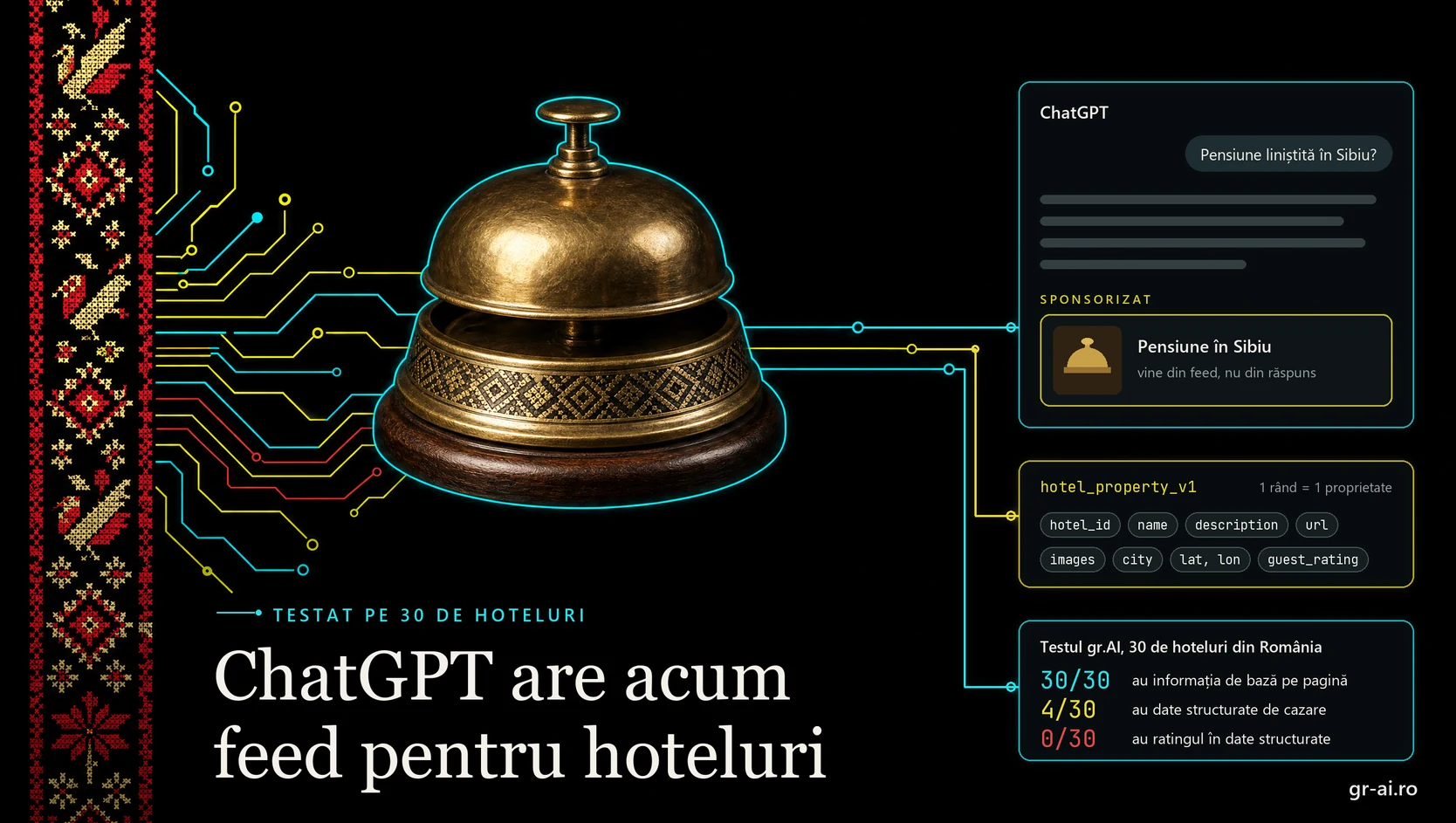
What does ChatGPT's new hotel feed mean for a hotel in Romania?
Since 1 October 2026, the ChatGPT Ads documentation has a separate guide for hotel feeds, in a closed beta, only for advertisers approved by OpenAI. The feed describes each property in a single row: name, description, public page, images, city, coordinates and, optionally, star rating, guest ratings and a “from” price. It has no rooms, no date-based rates and no availability. A Romanian company can buy ChatGPT ads today on a self-service basis, but nothing public shows that the hotel beta includes Romanian properties. And OpenAI says ads do not influence answers, so what ChatGPT writes about your hotel remains separate work. We checked 30 independent hotels and guesthouses in Romania: all have the basic information on the page, but only 4 also describe it in structured data, and none declares its rating.
What exactly OpenAI launched
The page is called “Hotel property feeds” and is labelled as a limited beta. The guide says plainly that this is not an open beta: it is for approved pilot advertisers only, and the fields and validation rules may change. There is no public sign-up form. If the hotel option does not show up in your account, the guide sends you to your OpenAI account team.
I dated it from two independent sources. The first is a public archive on GitHub that saves OpenAI's documentation several times a day: the guide is missing from the copy taken at 07:47 UTC on 1 October and present in the one taken at 20:31 UTC the same day. A few hours earlier, a sentence about “Hotel Insights” had already appeared in the reporting documentation. The second source is IntentPeak's changelog, the only outside observer I found that noted the page, on 4 October. There is nothing on OpenAI's blog and nothing in the ads API changelog.
There is one more detail, three weeks older. Around 11 September, the product feeds page was rewritten: it no longer says OpenAI accepts Google-compatible feeds, and it now has its own schema, with separate flags for search, checkout and ads. Hotels are the second category to get a feed of their own. The direction looks clear: OpenAI is building its own data formats rather than borrowing Google's.
What data the feed asks for
The basic unit is the property, not the room. One row is one hotel or guesthouse, with an identifier that must stay the same from one upload to the next. The required fields:
hotel_idstable identifier, max 100 charactersnamedisplay name, max 150 charactersdescriptionstatic description of the property, max 5,000 charactersurlthe property's public page, full addressimages1 to 20 public images; the first is the main onelocation.address.citythe citylocation.address.country_codethe country code, for example ROlocation.coordinateslatitude and longitude, in decimal degrees
Optional: brand, street, county, postal code, up to 20 neighbourhoods, a static “from” price (for example 149.00 USD), star rating (1 to 5, in half steps), a category and up to 20 guest ratings, each with the name of the rating system, the score, the maximum score and the number of reviewers. The advertiser types in the name of the rating system: the guide does not say which sources OpenAI accepts or how it checks them.
The file is a UTF-8 CSV or a tab-separated TXT, always sent in full, never in pieces. You upload it in Ads Manager, from a hosted HTTPS address or over SFTP. The API only lets you create the feed and set up SFTP. A successful upload does not mean every property was accepted: the diagnosis for each row shows up separately, in the upload history.
What is missing, on purpose
The guide lists what is outside the beta: rooms, offers, date-based rates, availability, partial updates. Undocumented columns are ignored, and the examples OpenAI itself gives include the phone number. There is no field for amenities, cancellation policy or check-in time either.
Google Hotel Center sells the room for a specific night, with prices and availability updated continuously. The OpenAI feed, for now, sells the property as a whole: who you are, where you are, what you look like, what score you have and where the price starts.
For a small hotel, that is a much lower technical barrier: a CSV, not a channel manager integration. But the product looks more like brand advertising than a price comparison engine. You are not selling a night on 14 November, you are selling the idea that you are a good option in Sibiu.
Where the ad shows up and what OpenAI promises
ChatGPT ads appear below the answer, labelled as sponsored and visually separate from the text. They carry the advertiser's name, logo, a title, a short text, an image and the landing page. The hotel guide does not describe a format of its own, so we do not know yet whether the rating or the “from” price shows up on the card. Only Free and Go users see them, not people on paid plans.
„Ads do not influence the answers ChatGPT gives you”
It is a promise we cannot verify from the outside, but it has a practical consequence: what ChatGPT says about your hotel in the answer remains an organic result. For product feeds, OpenAI writes explicitly that feed items appear only in ads while the beta lasts. For hotels, the guide says nothing either way.
One detail matters in Romania: there are no personalised ads in the European Economic Area yet. The ad is matched on the current conversation, on the hints the advertiser provides and on the landing page, which OAI-AdsBot, OpenAI's ads bot, reads. So the content of your page matters for the ad too, not just for the answer.
Romania: what you can do today and what you cannot
You can: a Romanian company can buy ChatGPT ads on its own, from Ads Manager. OpenAI's help center lists Romania among the countries available for self-service, and on 6 October, opened from Romania, ads.openai.com showed a credit offer in lei. Mind what the list means: the country of the company that buys and pays, not the country where the ad is shown.
You cannot, for now: the hotel feed requires approval into the pilot, through the OpenAI team. The guide does not say which countries the pilot runs in, and all its examples are fictional US hotels priced in dollars. That is not a restriction, but it is not a sign that Romania is included either. And that ads are actually shown to users in Romania I have only read in the press: OpenAI's official page on the European expansion names nine countries, and Romania is not among them.
Who already sits in travel answers
A GEOflux study, published by Revista Biz on 30 September, counted almost 42,000 ChatGPT, Gemini and Perplexity answers for users in Romania. In the travel category, Booking.com shows up in 53.2% of answers, followed by Skyscanner (34%), Google Flights (29.6%), Christian Tour (23.9%) and Airbnb (22.5%). The category mixes flights, packages and accommodation, and the figure counts mentions, not sales, so it is not a hotels-only number.
The overall picture stays the same, though: booking platforms already dominate the organic part, and they are also the most likely buyers of hotel ads at scale. An independent hotel competes twice: for the mention in the answer and for the sponsored block underneath.
Our test: 30 hotels and guesthouses in Romania
From OpenStreetMap, an open map, I took the hotels, guesthouses and hostels with a listed website in eight destinations: Bucharest, Brașov, Sibiu, Cluj-Napoca, Constanța with Mamaia, Sinaia, the Danube Delta and Maramureș. I removed hotel chains and duplicates, shuffled the list at random and went through the properties in order, until I had 30 working websites of their own: four in each of the first six destinations, three in the Delta and in Maramureș. I only read what anyone can see, without JavaScript and without an account, on 6 October 2026. I did not query Google or Booking automatically.
To get to 30 I drew 48 properties. For 13 of them, the website listed on the map did not respond even on a second attempt, and 3 only pointed to Facebook or to a booking platform. I removed two by hand: a chain that slipped through the filter and the website of an organisation rather than of the property.
What I found on the 30 websites:
- have text and images visible without JavaScript30 of 30
- mention their town on the page29 of 30
- do not block OpenAI's bots in robots.txt30 of 30
- use HTTPS25 of 30
- have a meta description14 of 30
- have hotel or lodging structured data4 of 30
- declare their coordinates in structured data2 of 30
- declare their rating in structured data0 of 30
In short: the basic information is there. Almost any of these properties could fill in its feed row tomorrow, because the name, the place, the description and the photos are already on the page. What is missing is the version for machines: only 4 of 30 describe the property in structured data, only 2 declare their coordinates, and none declares its rating. And for the two that do have coordinates, the open map shows a different point, 600 to 800 metres away. We do not know which source is wrong, but that is exactly the problem when an automated system tries to decide whether the hotel on the website, the one on the map and the one on Booking are the same place.
The good news: no robots.txt blocks OpenAI's bots. The less good news: none of them names the bots, so nobody made a conscious decision, and five sites have no robots.txt at all. And robots.txt does not catch blocks in the firewall or the CDN: one of the sites we drew refused our request outright, with a 403 error, and we cannot tell whether it does the same to OpenAI's bots.
The limits, stated plainly: a small sample, drawn from properties that have a website on the open map, so probably better organised than average; a single page, checked once, without JavaScript; no Google Maps and no Booking. We publish the method and the aggregate figures, not the list of properties.
What a hotel in Romania can do starting tomorrow morning
Nothing on the list below requires access to the pilot. All it does is prepare you for it and, at the same time, for organic answers.
- One public page for each property.
The feed asks for one public address per hotel, and the images must be public too. A group with three guesthouses needs three pages, not one shared page.
- The same data everywhere.
Identical name, address and coordinates on your site, in Google Business Profile, on Booking and on the other platforms. The feed requires coordinates, and Google uses them to match a hotel to location searches.
- A description of the property, not of the promotion.
The guide asks for a static description. The text on your site should say where you are, what kind of place it is and what sets it apart, not this season's offer.
- Ratings, noted with their source and number of reviews.
The Booking score out of 10, the Google score out of 5, each with its number of reviews. That way you can report them exactly, in the feed or anywhere else.
- Your own images, at stable addresses.
Between 1 and 20 per property, the first one is the main one. A representative photo, hosted on your own domain.
- The right bots, let in.
OAI-SearchBot for ChatGPT search, OAI-AdsBot if you run ads. Check your firewall or CDN as well, not just robots.txt. GPTBot, the model training bot, is a separate decision.
- Hotel or LodgingBusiness structured data.
This is our recommendation, not an OpenAI requirement: the guide does not say it reads schema.org. The value is consistency: the same data in the markup, on the page and in the feed. In our test, only 4 of 30 had it.
- Measurement, set up before the first leu is spent.
UTM parameters on the landing page and the OpenAI pixel or conversions API, installed before you start a campaign.
- The organic part, worked on separately.
The ad does not change the answer, according to OpenAI. What ChatGPT writes about you is built from accurate public sources: your site, your profiles, booking platforms, the press.
Frequently asked questions
- Can I put my hotel in ChatGPT's hotel feed now?
- Only if OpenAI approves you into the pilot. Access is requested through the OpenAI ads team. In the meantime, a Romanian company can run regular ads in ChatGPT on a self-service basis.
- If I send the feed, will ChatGPT recommend my hotel in the answer?
- No, according to OpenAI: ads appear separately, below the answer, and advertising does not influence the answers. For product feeds, OpenAI says explicitly that items do not appear in organic answers while the beta lasts. For hotels it says nothing.
- Do I have to send prices and availability?
- No. The feed only accepts a static “from” price, and it is optional. Date-based rates, availability and rooms are outside the beta.
- Which ratings can I send?
- Up to 20 rating systems, each with a score, a maximum score and a number of reviews. OpenAI does not publish a list of accepted sources, so only send public scores that anyone can check.
- Should I block OpenAI's bots on my site?
- Do not block OAI-SearchBot if you want to show up in ChatGPT search, and do not block OAI-AdsBot if you run ads, because it reads the landing pages. GPTBot, the model training bot, is a separate decision.
Where the data comes from
- OpenAI's guide to hotel feeds. “Hotel property feeds”, on developers.openai.com, read in full on 6 October 2026, together with the sample file and the rest of the ads documentation.
- The public archive of OpenAI's documentation. The GitHub repository llms-txt-archive/openai-platform, which I used to date the guide: between 07:47 and 20:31 UTC on 1 October 2026. Independently confirmed by IntentPeak's changelog, updated on 4 October.
- OpenAI's help center and pages. The pages on ads in ChatGPT, Ads Manager availability by country and campaigns from product feeds, plus the page on the European expansion (18 August 2026, updated 31 August), in its official Romanian version.
- OpenAI's documentation on bots. The page on OAI-SearchBot, OAI-AdsBot and GPTBot, on developers.openai.com.
- Google Hotel Center documentation. The integration guide for hotel prices and the hotel list glossary.
- Revista Biz, 30 September 2026. The article on GEOflux's “State of AI Search Romania” report, where the figures for Booking.com and the other platforms come from.
- Our own test. 30 hotels and guesthouses in eight destinations, drawn at random from OpenStreetMap and checked on 6 October 2026, read-only, without JavaScript.
Share this article
Further reading
- What the ad register ChatGPT has to publish will revealThe other half of ChatGPT ads: who pays and where it shows
- What structured data actually does for AIExactly what 26 of the 30 hotels in the test were missing
- How do I check whether an AI can read my siteThe same checks, done yourself, in ten minutes
- If you want the check run on your own hotelYour page, structured data, map and platforms, side by side