The AI, the money, and the Lipovan borscht of Jurilovca
by Cătălin Popa · updated 2026-09-07
The mayor of Jurilovca called it “a genuine case study in how easily people can be misled online”. He is right. But the case study is more interesting than it looks, because the part that can actually be demonstrated is not the part that was reported.

Why did ChatGPT recommend an event that does not exist?
Because at the moment it was asked, the only published documents about that event said it was happening. An answer engine does not verify reality. It summarises the documents it finds and ranks them by how easy they are to read, not by how entitled the author is to be believed. In Jurilovca there were dozens of commercial pages describing the festival in the present tense, as a fact, some online since May, and not one document from the organiser saying the 2026 edition was not taking place. The council's only festival page is a photo gallery from 2019, without a single date in it. When every document belongs to those who are selling, the answer belongs to them too. The fix is not in the model but at the source: one page per edition, with the year in the address, a start date, and an explicit eventStatus in the structured data, including EventCancelled when an edition does not happen.
What happened
Over the weekend of Saturday 5 and Sunday 6 September 2026, more than ten coaches and a good many private cars arrived in the commune of Jurilovca, Tulcea county, for the Lipovan Borscht Festival. The festival was not organised. The council had never announced it.
„We did NOT announce the festival, so it is NOT taking place.”
Context matters. The 2025 edition had been scheduled for 6 and 7 September and was suspended at the end of July 2025 for budget reasons. The last edition actually held was the 2024 one, and it drew 157,000 visitors over two days, according to the council's own press release, which called it the largest open-air festival in Dobrogea. Not a minor event that vanishes without anyone noticing.
The tourists came from two directions at once: trips sold by travel agencies since the summer, and confirmations obtained from ChatGPT. Some agencies withdrew their offers after the council intervened and apologised. Others insisted the festival was on “because that is what it says on the internet”. The director of FanTour, Ștefan Văduva, says he tried several times to phone the council to check and got no answer. That detail matters for everything that follows.
The evidence: a date that matched nothing
Here is the part that can be demonstrated, and it is the most important in the whole case. The mayor ran the test himself and published the result:
„I asked Chat GPT whether the Jurilovca Lipovan Borscht Festival is taking place this year and I got, astonishingly, the answer that yes, it is running this weekend, 4-5 September!”
Now compare the three dates:
- The 2025 edition, announced then suspended6 and 7 September
- What the agencies were selling for 20265 and 6 September
- What ChatGPT answered4 and 5 September
The date the model gave matches none of them. On top of that, 4 September 2026 was a Friday, so it was not even the weekend it was describing.
Which means the model did not quote a source. It reconstructed a plausible date from a pattern, something along the lines of “autumn festival, early September”, and delivered it with the same confidence it would have given a verified fact. The commercial pages gave it the certainty that the event existed. The rest it filled in on its own.
The distinction is useful for anyone trying to understand what broke: the model did not invent the festival, it believed in it. Once it believed, it filled in the missing details.
Who had a reason to publish a date
This is the question nobody asked, and it is the one that explains everything.
Here is the page that sold the trip. It was taken down after the story broke. We recovered it from the Internet Archive, where a single capture exists, made on 20 May 2026, three and a half months before the weekend in question.
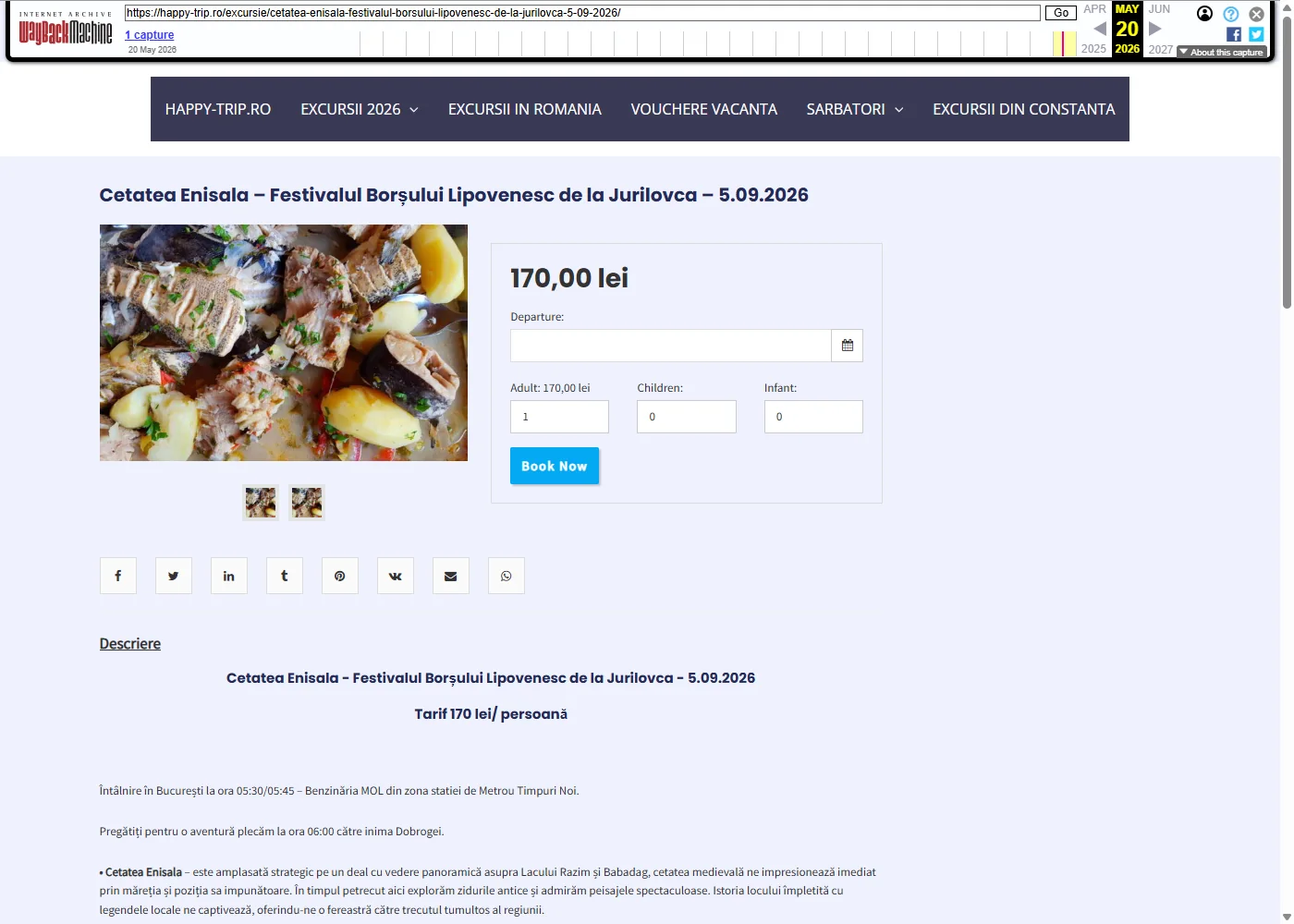
Look at that button. It does not say “it might happen”. It says Book Now, under a price of 170 lei.
That is the difference between a mistake and a product. Someone built a page, put a price on it, wired it to a booking form and left it online for a quarter of a year. Somewhere, a person decided it was worth the effort.
The press named six agencies selling trips to the 2026 edition: Cistour, Hello Holidays, DabTour, FanTour, Family Trip and Happy Trip, at prices between 100 and 210 lei per person. We found pages on five more domains.
An order-of-magnitude calculation, with the assumption stated. The Happy Trip page required a minimum group of 40. The council reported more than ten coaches. If each left with that minimum of 40 people, at prices between 100 and 210 lei, that is somewhere between 40,000 and 84,000 lei taken for a day at a festival that did not exist. The figure is ours, derived from the publicly reported number of coaches and the prices published on the websites. We have no sales data from the agencies, and some cancelled or redirected their trips to Gura Portiței.
Now the other side of the calculation. What would it have cost for none of this to happen? One page. A headline saying “The 2026 edition is not taking place” and three lines underneath. One morning's work, once, for free.
That is the gap. Ten companies had a clear financial reason to publish a date. Nobody had any financial reason to publish that there was no date. And an answer engine reads exactly what was published, not what should have been.
What was published, checked page by page
Checked by us, directly, on 7 September 2026:
- happy-trip.ro404. Recovered from the Internet Archive, captured 20 May 2026
A complete offer for 5.09.2026, with itinerary, a 170 lei price and a booking button
- helloholidays.roStill published, with no warning that the edition never happened
Title carrying “2026”. The text says “we take part in the Lipovan Borscht Festival”
- visitjurilovca.roStill published
Presents the festival. No date, no year, no mention of suspension. The only marker is a link to “The 2024 edition”
The second one you can check yourself, right now. This is how it looked on the evening of 7 September 2026, two days after the weekend when people travelled to Jurilovca for nothing:
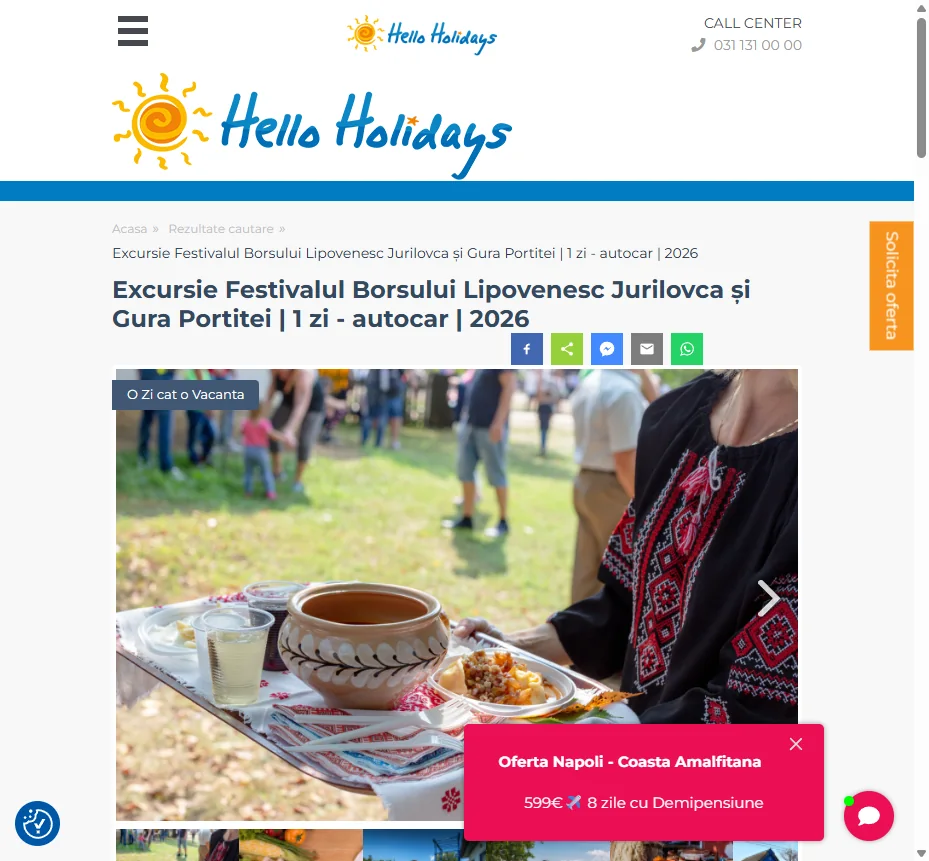
The text of the offer read exactly like reporting:
„The Lipovan Borscht Festival in Jurilovca opens its gates and welcomes us into a vibrant atmosphere. We are surrounded by traditional music and dancing…”
Present tense. No “subject to confirmation”. No organiser cited, no source, no publication date. To a machine that cannot phone the council, this text is indistinguishable from a news report.
Around the agency pages there was a second ring, of aggregators copying them: event entries with no year, plus copies of the offer on event platforms. Each copy adds an apparently independent confirmation. But they are not independent sources. It is the same source, four times over.
What was missing, and why
The first explanation that comes to mind is that the council has no website. That is not true, we checked.
Jurilovca council has a website, and it even has a page dedicated to the festival. We opened it on 7 September 2026. It contains eleven photographs from the 2019 edition. No text, no description, no dates, no mention of how often it runs, no publication date. Just pictures.
For a machine trying to work out whether the festival is happening in 2026, that page is worse than nothing. It confirms the festival is real and belongs to the council, while saying nothing about time. It adds to the pile of evidence that the event exists and contradicts none of it.
There is another layer. The commune is also present online through a separate tourism site, with a festival page that is equally undated. The name “Jurilovca” is split across two domains, neither of which says what year it is.
Now the part that explains the rest. On 10 May 2025, the council issued an official press release through AGERPRES to announce the 2025 edition: 6 and 7 September, the largest open-air festival in Dobrogea, 157,000 visitors in 2024. Distributed, picked up, indexed. The institution knows perfectly well how to publish something so that it travels.
For 2026 there is no equivalent document. No release, no page, no announcement. And that is not negligence, it is the rule, everywhere:
Institutions communicate events. They do not communicate non-events.
Nobody issues a press release about what is not happening. When a festival runs, an announcement appears. When it does not, silence appears, and silence is not indexed. An answer engine cannot weigh a statement that does not exist. Between dozens of pages saying “it is on” and zero pages saying “it is off”, there is no dilemma to resolve.
What the council did say, it said through channels that never reach an index: on the phone, to the agencies that called, and on Facebook, after the coaches had already arrived.
What ChatGPT answers now
We ran it ourselves on 7 September 2026, logged out, with web search enabled.
Is the Lipovan Borscht Festival taking place in Jurilovca in 2026?
„No. […] it is not being organised in 2026 and there is therefore no official date for this year's edition.”
In a clean chat, with no context: I want to go with my family in 2027. When does it take place?
„I cannot find an official announcement yet […] I would not rely on a date published by a travel agency until it is confirmed by Jurilovca council.”
So it is fixed. But look at why it is fixed. The model cites AGERPRES, Ora de Tulcea, Antena 3 and Timpul Gorjului, which is to say the press that covered the incident. Jurilovca council is cited in neither answer.
Nobody repaired the model. Over thirty articles were published, and those now dominate the index for this festival's name. The answer changed because what was published changed.
The AI answer followed the index, in both directions. It is neither smarter nor dumber than it was in August. It has different documents.
One detail says a lot about how a source gets picked: on a story from Tulcea, the first citation is a newspaper from Gorj, at the other end of the country. Engines do not rank by authority or proximity, but by what is indexed, clean and easy to extract. A small newsroom's tidy site beats the clunky site of the institution that holds the truth.
The mechanism, in three steps
What happened in Jurilovca is not specific to Jurilovca. There are three conditions that, together, produce this kind of error again and again.
- 1
Clone and increment
The agency reuses last year's page and changes the year in the title and the address. Nobody checks with the organiser. A “2026 edition” appears that never existed, with an itinerary, a price and a departure time.
- 2
Pages with no year
The destination site and the aggregators describe the event as a permanent institution: “the festival takes place in Jurilovca”, with no edition, no date, no year. To a model, an undated page is true forever.
- 3
The organiser's asymmetry
The one who knows the truth publishes when the event is on and stays silent when it is off. The announcement gets indexed, the absence does not. After two years without an edition, the last official document about the festival is still the one announcing it.
The first two conditions are near universal in tourism. The third is the only one the organiser controls completely, and the only one that can produce the missing document.
How it gets fixed
The fix is cheap and checkable. It is not about fighting the AI, it is about publishing the document that was missing.
- a
One page per edition, with the year in the address
/festival/2026, not /festival. A page per year can be dated, archived and contradicted. An eternal page can only be believed.
- b
Event in structured data, with an explicit status
This is the field almost nobody fills in, and it solves exactly this problem:
{
  "@context": "https://schema.org",
  "@type": "Event",
  "name": "Festivalul Borșului Lipovenesc, ediția 2026",
  "startDate": "2026-09-05",
  "endDate": "2026-09-06",
  "eventStatus": "https://schema.org/EventCancelled",
  "eventAttendanceMode": "https://schema.org/OfflineEventAttendanceMode",
  "location": {
    "@type": "Place",
    "name": "Jurilovca",
    "address": {
      "@type": "PostalAddress",
      "addressLocality": "Jurilovca",
      "addressRegion": "Tulcea",
      "addressCountry": "RO"
    }
  },
  "organizer": {
    "@type": "GovernmentOrganization",
    "name": "Primăria Comunei Jurilovca"
  },
  "url": "https://exemplu.ro/festival/2026"
}
For a cancelled edition, startDate stays the originally scheduled date and eventStatus becomes EventCancelled. That is the schema.org rule, and the only way a machine understands “it was scheduled, it is not happening any more”. For a postponement, use EventRescheduled with previousStartDate.
- c
A denial page, indexable
A headline containing exactly the question people ask, “Is the Lipovan Borscht Festival on in 2026?”, and in the first paragraph the whole answer, standing on its own. Engines extract paragraphs, not pages. If the answer sits under the fourth subheading, it does not exist.
- d
Publication and modification dates on every page
datePublished and dateModified, visible to humans and present in the structured data. That includes archive pages, which are the ones most often forgotten. An undated photo gallery, like Jurilovca council's, with pictures from 2019 and not a word about when, is not neutral. A title in the form “Lipovan Borscht Festival, 2019 edition” fixes it in one line.
- e
One domain for one name
When an entity's identity is split across two sites that do not link to each other, neither accumulates enough authority to beat eleven commercial domains. Pick one as canonical, have the other point to it, and let sameAs tie the official profiles together.
- f
Check whether your server lets the crawlers in
robots.txt is a statement of intent. The firewall or CDN can answer something else entirely, without anyone knowing. The crawlers that bring citations from ChatGPT, Claude and Perplexity are OAI-SearchBot, ClaudeBot and PerplexityBot. This check appears in no classic SEO audit, because classic SEO tests with Googlebot, and Googlebot gets through.
- g
For agencies, one rule
Do not publish a date you have not confirmed in writing with the organiser. And if the organiser does not answer, as FanTour says happened, write that on the page. Do not paper over it with last year's text.
What we do, at gr.AI
Our services cover exactly the three conditions in the mechanism, and this case showed us they are worth naming together, as one flow.
- GEO SCAN
Measures what the five engines answer to the questions your customers ask about you, and what a machine can actually read from your site. This is where undated pages and firewall-blocked crawlers surface.
- AI MIRROR
Runs over a hundred queries and looks not only at what is said about you, but at who gets cited instead of you. In Jurilovca, the answer would have been: eleven travel agency domains and a photo gallery from 2019.
- SCHEMA FORGE
Puts Event, eventStatus, the dates and llms.txt where they belong, and builds the edition page that can be contradicted next year.
Before each edition, we ask the five engines what they know about your event: whether it is on, when, who runs it, what it costs. We compare that with the truth and repair the source. For an organiser, it is the difference between learning from the press that ten coaches turned up for nothing and knowing three months ahead what is being written about you.
It is also the segment we had not gone after: councils, tourist information centres, festival organisers. The argument is simpler than with any commercial client, because it is not hypothetical.
And the reverse applies to anyone who sells anything. An old, undated page keeps speaking in your name long after you have forgotten it. At our check on 7 September 2026, one agency still had a “2026” page published for an event that never happened. Nobody put it there in bad faith. It is just that nobody took it down.
Conclusion: where it could have stopped
The press offered two convenient explanations. One: the AI got it wrong. The other: people were gullible for asking a chatbot instead of phoning the council. Both have the advantage of ending quickly.
We have neither the standing nor the data to establish who is legally liable. That gets decided between contracts and a courtroom, not in an article. But we can do something else, and it is more useful: we can reconstruct the points at which the chain could have broken. At each one, two checkable things, nothing more. What could have been known at the time from public sources, and what the other option would have cost.
- 1
The document nobody wrote
What existed publicly about the 2026 edition from the organiser: nothing. What was on the council's website: a gallery of eleven photos from 2019, without a single date. The last official announcement about the festival was still the May 2025 release announcing it.
The other option would have cost: one page with a headline and three lines. No law required it.
- 2
The date published without a source
Eleven domains displayed a firm date for 2026. The Happy Trip page had been online since 20 May, with a price and a booking button. None of the pages cites an organiser and none says where the date came from. FanTour's director stated publicly that he tried several times to contact the council and got no answer, and the agency later offered its customers an alternative trip to Gura Portiței. For none of the companies do we know what was checked, or when. The question stays open, and it is theirs: what was the date based on?
The other option would have cost: one line on the page. “Date announced by us, not yet confirmed by the organiser.”
- 3
The copies that turned one source into four
The same offer appeared on aggregators, undated and unattributed. Anyone wanting to check found four pages saying the same thing and had every reason to believe they were four sources.
The other option would have cost: a date and one line of attribution on each copy.
- 4
The answer given without flagging the uncertainty
The date the mayor received, 4 and 5 September, appears in no known source. It was not the previous edition's date, and it was not what the agencies were selling either. The answer carried no sign that the date was reconstructed and unconfirmed.
The other option would have cost: one sentence. “The agencies announce 5 September, but I find no confirmation from the organiser.” With that on screen, ten coaches would not have filled.
- 5
The check that looked like a second opinion
People did what they are generally advised to do: they sought confirmation elsewhere. Except the two sources were not independent. The model had read the agency pages themselves. Two sources that look different and are not, that is a trap which catches the careful too.
The other option would have cost: a phone call to the council. Assuming someone answered, which, according to FanTour's statement, did not always happen.
Four of the five points could have been fixed by publishing a document. None of them cost as much as the damage it caused.
Beyond the apportioning each reader will do for themselves, there is a shift worth naming, because it is new. As long as people searched on Google, the absence of information looked like an absence. You found nothing and worked out for yourself that nothing was known. An answer engine does not behave that way. It does not hand you a gap, it hands you the best sentence it can build from what it found. The gap fills itself, with whatever is lying around.
Out of this comes an obligation no law yet requires: if you own a name, you also have to publish what is not happening to it. Not for the algorithm. For the ten coaches.
What we cannot demonstrate
The rule we apply to others applies to us too, otherwise this article is worth nothing.
- We did not reproduce the original error. Our tests come after the news broke, when the correction was already in the index. We cannot show you the “yes”. We can only quote it from the mayor's post.
- Two runs, two phrasings, one engine, logged out. Far too little for a claim about causes. What is written above is an observation and a plausible mechanism, not a proven explanation. A causal claim would need dozens of runs across several phrasings, on all five engines.
- Nobody knows which model, which version or which phrasing the tourists used. Nobody has their conversations.
- The money calculation is ours, derived from the publicly reported number of coaches and the published prices. We have no sales figures from the agencies, and some cancelled or redirected their trips.
- The per-agency prices are taken from press reports. We did not verify them on each page.
- The figure of 157,000 visitors comes from the council's press release, so it is declared by the organiser, not independently measured.
- On the council's site we checked the home page and the festival page, not the entire site. There may be an announcement somewhere we did not find. But if neither we nor the engines find it, the argument stands.
- The press gives two versions of the weekend, 4 and 5, or 5 and 6 September. The Saturday and Sunday were the 5th and 6th. We kept 4 and 5 only where the mayor is quoted, because that is what the model told him.
Where the data comes from
- The incident. Mayor Eugen Ion's public post, carried by Radio România Constanța on 6 September 2026, plus reports in AGERPRES, Adevărul, G4Media, Antena 3, Aktual24, Ora de Tulcea and Gândul, on 6 and 7 September 2026.
- The 2025 suspension and the festival's figures. Reports in G4Media, DCNews and funkytravel.ro from 30 July 2025, plus Jurilovca council's press release distributed through AGERPRES on 10 May 2025, announcing the 2025 edition and citing the figure of 157,000 visitors in 2024.
- The pages, checked by us. The happy-trip.ro offer for 5.09.2026, recovered from the Internet Archive, captured 20 May 2026. The helloholidays.ro and visitjurilovca.ro pages and the council's festival page, opened directly on 7 September 2026. The screenshots are in the article.
- The markup rules. The schema.org documentation for the Event type and the eventStatus, startDate and previousStartDate properties.
Share this article
Further reading
- What structured data is for, when it comes to AIEvent and eventStatus are just two fields in a larger set
- The mistakes that make you invisible to AI enginesIncluding undated pages and crawlers stopped at the firewall
- All the questions explainedIn the order it makes sense to read them
- If you run an event and want the check done beforehandWhat the five engines know about your event, three months ahead